
When deciding between manual and algorithmic trading, the choice depends on your trading style, goals, and resources. Here’s a quick breakdown:
- Manual Trading: Relies on human judgment, intuition, and experience. Offers flexibility to respond to unexpected events but is slower and prone to emotional biases.
- Algorithmic Trading: Uses automated systems to execute trades based on predefined rules. It’s faster, consistent, and scalable but requires technical expertise and can struggle with unforeseen market changes.
Both methods have strengths and limitations. Manual trading works well for unpredictable markets and qualitative analysis, while algorithmic trading excels in speed, precision, and handling large datasets. Many traders combine both to leverage the benefits of each.
Quick Comparison
| Factor | Manual Trading | Algorithmic Trading |
|---|---|---|
| Speed | Slower (minutes to hours) | Faster (milliseconds) |
| Emotions | Prone to emotional biases | Emotion-free |
| Flexibility | High for unique situations | Limited to pre-set rules |
| Costs | Low (basic tools) | High (hardware, software) |
| Scalability | Limited | High |
| Expertise Needed | Market analysis | Programming, quantitative skills |
Both methods suit different scenarios, and combining them can offer the best results. Choose based on your skills, risk tolerance, and trading objectives.
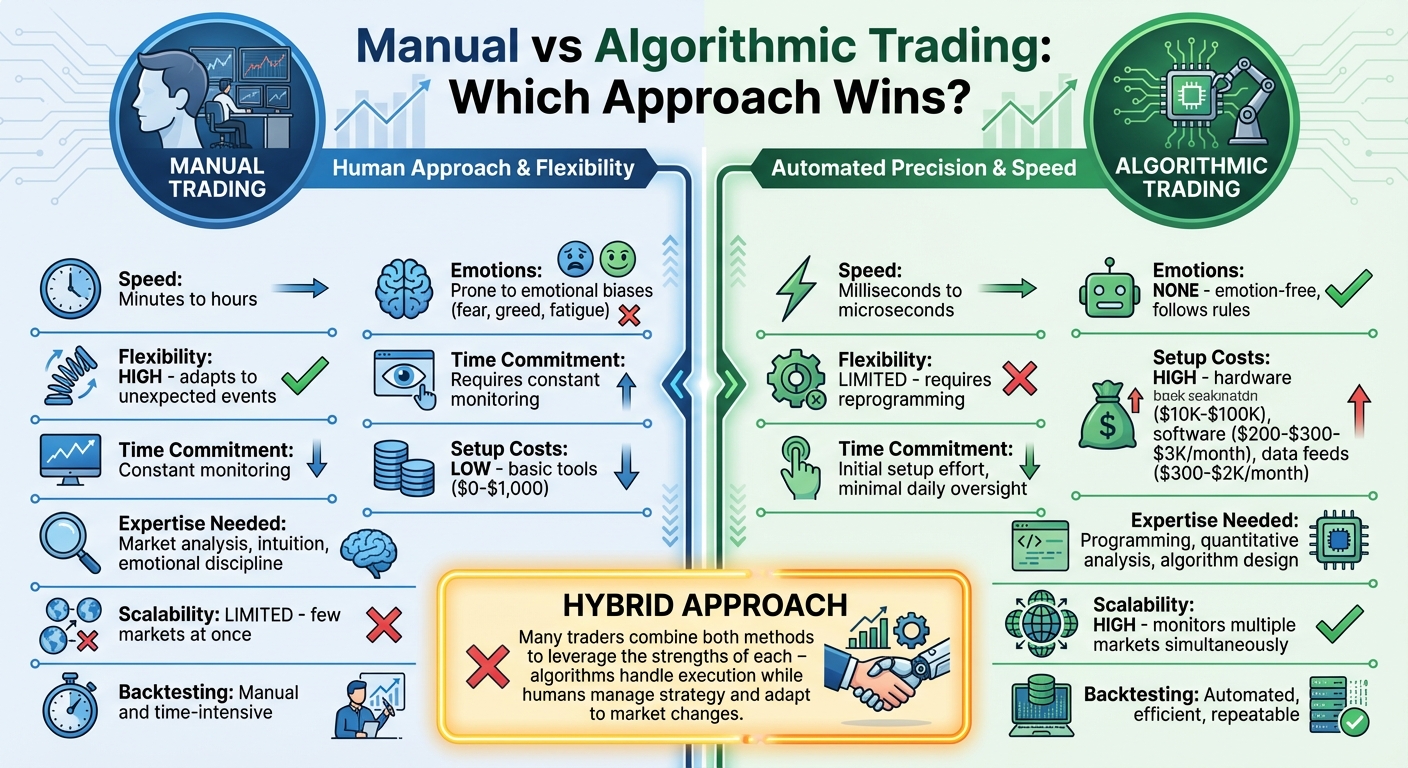
Manual vs Algorithmic Trading: Key Differences Comparison Chart
Algo Trading vs. Manual Trading (Best One For You)
What Is Manual Trading?
Manual trading is all about making your own trading decisions – no automated software involved. It’s a hands-on approach where you rely on your own analysis, intuition, and experience to decide when to buy or sell. Every decision, from entering to exiting a trade, is entirely up to you.
This method requires you to actively analyze market conditions and execute strategies in real time, putting you in the driver’s seat for every move.
How Manual Trading Works
At its core, manual trading is powered by human judgment. You assess market conditions using a mix of technical and fundamental data, making adjustments as situations evolve. Unlike automated systems, which follow pre-programmed rules, manual trading allows you to adapt quickly to unexpected changes.
This flexibility is supported by a variety of tools that traders use to make informed decisions.
Tools Manual Traders Use
Manual traders rely on a mix of tools to guide their decisions. These include:
- Charting platforms for tracking price movements
- Real-time news feeds to stay updated on market events
- Economic calendars for upcoming data releases
- Scanners to identify trading opportunities
- Order execution systems for placing trades efficiently
Many traders also keep trading journals to document their strategies and decisions, which helps them learn and improve over time. Additionally, backtesting software is often used to test strategies against historical data.
Successful manual traders rarely depend on just one indicator. Instead, they combine two to four complementary tools. For instance, you might pair moving averages with the relative strength index (RSI) and volume analysis to validate your trade setups. And before diving into live trading, demo accounts are a great way to practice and refine your skills without any financial risk.
What Is Algorithmic Trading?
Algorithmic trading takes the guesswork out of decision-making by automating trades based on predefined rules. Instead of manually analyzing charts and market trends, you set up rules that trigger trades automatically using real-time data. Unlike human traders, algorithms don’t get emotional – no panicking during a market dip or overconfidence during a rally. They simply stick to the plan.
This type of automation has become a cornerstone of modern trading, with computerized systems dominating the markets. The real edge of algorithmic trading lies in its speed and reliability. These systems operate at lightning-fast speeds – milliseconds or even microseconds – processing market data and executing trades far quicker than any human can. As Alex Pierrefeu, CPO & Co-founder at LuxAlgo, explains:
"Algorithmic trading leverages automated, high-speed systems for data-driven trades, while traditional trading relies on human intuition and adaptability".
Now, let’s break down how these systems actually work.
How Algorithmic Trading Works
It all starts with defining your trading strategy. You can do this by writing code if you’re tech-savvy or by using a no-code platform for simplicity. Once set up, the algorithm continuously scans market data for specific triggers – like price changes, volume spikes, or technical indicators. When the conditions match your rules, the system executes the trade automatically, with no need for manual input.
This automation means your strategy can run around the clock, monitoring multiple markets simultaneously. It’s a level of efficiency that human traders simply can’t match.
Tools Algorithmic Traders Use
To create and execute an algorithmic trading strategy, you’ll need some essential tools and technology. First, you’ll require powerful hardware capable of handling large data streams quickly. Then, you’ll need professional-grade trading platforms and reliable market data feeds. Here’s a rough breakdown of costs:
- Hardware: $10,000–$100,000 upfront
- Software: $200–$3,000 per month
- Data feeds: $300–$2,000 per month
For those skilled in coding, platforms like QuantConnect offer support for Python and C++, allowing you to build custom algorithms. If coding isn’t your thing, no-code platforms like Composer and Tradetron make it easy to design strategies with drag-and-drop tools. Another crucial element is backtesting – testing your strategy against historical market data to ensure it works before you trade live. Tools like MillionMachine specialize in backtesting and optimization, while APIs and trading bots help keep your system running smoothly and executing orders without interruption.
Manual vs Algorithmic Trading: Direct Comparison
When comparing manual and algorithmic trading, the differences become clear in areas like speed, emotional impact, and the resources they require.
Execution and consistency are where the contrast is most pronounced. Algorithmic trading systems operate at lightning speed, executing trades in milliseconds or even microseconds. They process market data and place orders far faster than any human could manage. On the other hand, manual trading involves significantly more time – often minutes or hours spent analyzing charts and executing trades. Algorithms stick rigidly to predefined rules, avoiding the pitfalls of second-guessing or emotional interference. In contrast, manual traders must navigate emotions like fear, greed, and fatigue, which can cloud judgment. As LuxAlgo explains:
"Automation in algo trading removes human emotions and biases from the decision-making process, leading to more disciplined and consistent execution. In traditional trading, human emotions can influence decision-making and introduce potential biases."
However, manual trading has its strengths. It allows traders to respond quickly to breaking news, geopolitical developments, or other unforeseen market events – situations where algorithms, bound by their programming, may struggle to adapt. The human ability to interpret nuanced signals and exercise intuition can be a valuable asset in such unpredictable scenarios.
Here’s a side-by-side breakdown of the key differences:
Comparison Table
| Factor | Manual Trading | Algorithmic Trading |
|---|---|---|
| Execution Speed | Minutes to hours for analysis and execution | Milliseconds to microseconds |
| Emotional Influence | High – prone to fear, greed, and fatigue | None – follows predefined rules without bias |
| Flexibility | High – can adapt quickly to unexpected events | Limited – requires reprogramming for adjustments |
| Time Commitment | Requires constant monitoring during trading hours | Initial setup effort; minimal daily oversight |
| Setup Costs | Low – basic tools like a laptop and brokerage account | High – includes hardware, software, and developer fees |
| Expertise Required | Market analysis, intuition, and emotional discipline | Programming, quantitative analysis, and algorithm design |
| Scalability | Limited – typically tracks a few markets | High – monitors and trades across multiple markets |
| Backtesting | Manual and time-intensive; subjective | Automated, efficient, and repeatable |
This comparison highlights the strengths and limitations of both approaches, offering insights into which might suit different trading styles or goals.
Manual Trading: Pros and Cons
Manual trading comes with its own set of strengths and challenges. Understanding both sides can help traders determine whether this approach aligns with their trading style and objectives.
Benefits of Manual Trading
One of the standout advantages of manual trading is the ability to respond directly to market dynamics. Unlike automated systems, human traders can quickly adapt to unexpected market shifts, leveraging their intuition and experience to interpret subtle signals. This includes assessing market sentiment, analyzing economic trends, and drawing insights from news events. Through practice, traders develop pattern recognition and can make informed decisions even in complex or conflicting situations. As SSA Group aptly describes:
"Manual trading is like driving a car – you have direct control over every action, feeling the market’s pulse through your own analysis and decision-making."
Another key benefit is personalization. Traders can tailor their strategies to fit their unique preferences, risk tolerance, and financial goals. Whether it’s taking advantage of short-term inefficiencies or spotting temporary pricing anomalies, manual trading allows for a flexible and creative approach that automated systems might overlook.
However, these advantages come with some notable challenges.
Drawbacks of Manual Trading
While manual trading offers control and adaptability, it has some serious limitations. One of the most significant drawbacks is speed. Automated systems can execute trades in milliseconds, while manual traders typically take 10–15 seconds to analyze and act. In volatile markets, this delay can mean missed opportunities.
Another major challenge is emotional decision-making. Emotions like fear, greed, or overconfidence can cloud judgment, leading to impulsive actions. For instance, traders might close winning positions too early, hold onto losing trades for too long, or engage in excessive trading. Mike Bellafiore, co-founder of SMB Capital, cautions:
"Successful professional traders know that their greatest enemy is in their own minds. The emotions of fear and greed are more powerful than any market forces in creating losses."
Manual trading also demands significant time and energy. Constant monitoring of the markets can lead to fatigue, which in turn impairs decision-making. Humans are also limited in their ability to process large amounts of data or manage multiple markets simultaneously. Mistakes in order entry – like placing a buy order instead of a sell – can result in costly errors, and performance often fluctuates depending on the trader’s mental state and focus.
These pros and cons set the stage for understanding when manual trading might be the better choice for certain traders.
sbb-itb-e64548c
Algorithmic Trading: Pros and Cons
Let’s dive into the specific advantages and challenges of algorithmic trading to better understand whether this automated approach aligns with your trading goals.
Benefits of Algorithmic Trading
One of the standout advantages of algorithmic trading is its incredible speed. Algorithms can execute trades in milliseconds or even microseconds – something no human trader could ever achieve. In high-frequency trading (HFT), these systems can process thousands of trades every second, allowing traders to capitalize on fleeting opportunities with pinpoint accuracy.
Another major perk is the removal of emotional bias. Unlike human traders, algorithms stick to predefined rules, steering clear of the fear, greed, or hesitation that often lead to impulsive decisions. This is a big reason why, by 2009, over 60% of U.S. trades were being executed by computers – a figure that has climbed to about 75% today.
Algorithmic trading also shines when it comes to scalability. A single system can monitor and trade across multiple markets at the same time, operating around the clock as programmed. Plus, the ability to backtest strategies using historical data gives traders a chance to fine-tune their approach before risking any real money.
That said, no system is perfect, and algorithmic trading has its share of challenges.
Drawbacks of Algorithmic Trading
While its strengths are impressive, algorithmic trading does come with some significant downsides. One of its biggest vulnerabilities is its reliance on technology. System failures, glitches, or other technical issues can disrupt trading and lead to major losses. For instance, on February 22, 2021, a technical problem forced the National Stock Exchange (NSE) in India to halt operations for nearly six hours, leaving intraday traders exposed to unexpected overnight risks.
Another challenge is the risk of poor data quality and overfitting. Overfitting happens when a trading strategy works well on historical data but fails in live markets, leading to disappointing results.
Cost is another factor to keep in mind. Setting up an algorithmic trading system isn’t cheap. Hardware costs can range anywhere from $10,000 to $100,000, and software fees typically fall between $200 and $3,000 per month. On top of that, there are ongoing expenses for maintenance, updates, and data feeds.
Lastly, algorithms lack human judgment and adaptability. They can struggle to handle sudden, unexpected market shifts. A prime example of this is the flash crash on May 6, 2010, when the Dow Jones Industrial Average plunged 1,000 points before bouncing back. This dramatic event, triggered by a large sell order and a surge of high-frequency trades, exposed the systemic risks tied to automated trading.
Weighing these pros and cons can help traders determine if algorithmic trading aligns with their risk tolerance, market approach, and comfort with technology. These considerations naturally lead us to explore how MillionMachine enhances backtesting and optimization.
Using MillionMachine for Backtesting and Optimization
MillionMachine offers a practical solution for traders diving into algorithmic trading but feeling overwhelmed by technical hurdles. With this platform, you can design, test, and fine-tune trading strategies without writing a single line of code. Its visual interface allows you to translate your trading ideas into plain-language rules and immediately see how those rules would have performed on historical price charts.
After creating a strategy, MillionMachine’s parameter optimization tools let you explore thousands of variations. You can evaluate performance across five asset classes – stocks, futures, currencies, ETFs, and cryptocurrencies. This flexibility helps you assess how well your strategy adapts to different markets and conditions.
A standout feature of the platform is its overfitting protection. By running Monte Carlo simulations, MillionMachine ensures that your strategy’s past success isn’t just a result of curve fitting – a common issue that can lead to poor results in live trading. This rigorous testing process builds confidence before you take your strategy live.
Additionally, the platform generates comprehensive performance reports containing key metrics like win rate, drawdown, profit factor, and risk-adjusted returns. These reports make it easy to compare multiple strategies side by side and align them with your trading objectives.
Whether you’re experimenting with a basic moving average crossover or a more intricate multi-indicator setup, MillionMachine provides the tools to systematically validate your ideas. By automating the heavy lifting of backtesting and optimization, it enables traders to overcome manual limitations and refine their strategies with precision. This integration of human insight and algorithmic rigor helps traders identify the most effective trading approaches.
Which Approach Works Best and When
Choosing the right trading method boils down to understanding the market environment and aligning it with your personal trading style. Both manual and algorithmic trading shine under different circumstances, and knowing when to use each can make a significant difference.
When Manual Trading Works Best
Manual trading thrives in markets influenced by unpredictable, qualitative events – like geopolitical tensions, policy changes, or breaking news. These are situations where human intuition and judgment outperform rigid, pre-set rules. For instance, interpreting Federal Reserve announcements, analyzing earnings calls, or spotting unusual trading behavior are areas where skilled traders can excel.
It’s especially effective during periods of extreme volatility or when the market undergoes structural shifts. When historical patterns or correlations break down, experienced traders can quickly adapt their strategies. They can factor in broader economic trends, political developments, or industry-specific nuances that algorithms might overlook. This ability to respond in real-time becomes crucial during crises, where fear and uncertainty often drive market movements more than technical indicators.
When Algorithmic Trading Works Best
Algorithmic trading comes into its own when speed, precision, and scalability are critical. If your strategy involves executing dozens – or even hundreds – of trades daily across multiple instruments, automation isn’t just helpful; it’s essential.
Algorithms excel when trading relies on clear, testable rules. Whether your edge lies in statistical patterns, technical indicators, or quantitative models, algorithms can execute these strategies flawlessly. They don’t hesitate, get emotional, or deviate from the plan. They stick to position sizing rules, maintain discipline during drawdowns, and seize opportunities within milliseconds. In markets with consistent patterns and ample liquidity, algorithms can turn small statistical advantages into meaningful gains over thousands of trades.
Using Both Methods Together
Rather than picking one approach over the other, many traders find success by combining the strengths of both. This hybrid strategy merges the efficiency of technology with the insight and intuition of human judgment.
For example, algorithms can handle repetitive tasks like order execution, stop-loss management, position sizing, and performance tracking. Meanwhile, traders can focus on higher-level tasks like strategy development, risk assessment, and reacting to unexpected market events. Automating processes like pre-set stop-losses and drawdown limits ensures discipline, while human oversight allows for flexibility and strategic adjustments based on market sentiment.
Conclusion
There isn’t a one-size-fits-all trading approach. The best method for you depends on factors like your skills, goals, risk tolerance, and available resources. If you enjoy making quick decisions and analyzing qualitative factors like policy shifts or earnings reports, manual trading might align with your strengths. On the other hand, if you value speed, precision, and emotion-free execution driven by data, algorithmic trading could be the better fit.
Both approaches have their place in today’s markets, and many traders find success by combining them. For example, algorithms can handle repetitive tasks such as order execution and stop-loss management, while human judgment is applied to strategy creation and market analysis. This hybrid approach takes advantage of the strengths of both methods.
Before putting any strategy into action, rigorous backtesting is crucial. Whether you’re working on quantitative models or fine-tuning a discretionary strategy, testing against historical data can help you gauge how your approach might perform under different market conditions. It also helps you identify weaknesses and avoid costly mistakes when trading live. Testing is a vital step in refining and validating your methods.
As mentioned earlier, blending algorithmic efficiency with human insight can yield powerful results. Tools like MillionMachine make it easier to backtest and optimize your strategies across various asset classes, even without coding knowledge. This enables you to validate your ideas before risking real capital.
The ultimate goal is to align your trading style with your unique circumstances and continuously work on improving your edge. Start by assessing your technical expertise, time availability, and emotional discipline. Then, use tools to test, refine, and enhance your strategies over time.
MillionMachine.com is a platform designed for research, education, and strategy development. Nothing on the site or within the platform should be interpreted as personalized investment, trading, or financial advice, nor as a solicitation to buy or sell any financial instrument. MillionMachine does not make recommendations or provide guidance on the suitability of any particular strategy, trade, or investment.
Users are fully responsible for evaluating their trading decisions and associated risks. All simulations, backtests, and analytics generated by MillionMachine are hypothetical and do not guarantee future performance. Hypothetical results come with inherent limitations and do not reflect actual trading outcomes. Real-world results may differ significantly.
MillionMachine is not registered as a Commodity Trading Advisor (CTA), Investment Advisor, or Broker-Dealer with the NFA, CFTC, SEC, or any other regulatory authority. While the founder was previously registered as a CTA with the National Futures Association (NFA), that registration is no longer active, and MillionMachine does not provide regulated advisory services.
The platform does not execute trades, manage customer funds, or grant access to real-time trading accounts. Any integration with broker APIs is solely for user-initiated automation, and users are responsible for ensuring compliance with applicable laws, regulations, and broker requirements.
All market data, charts, signals, and analytics provided by MillionMachine are for informational and educational purposes only. MillionMachine does not verify the accuracy or completeness of market data and assumes no liability for errors, delays, or omissions.
Trading financial instruments – including futures, stocks, cryptocurrencies, and derivatives – carries significant risks and may not be suitable for everyone. It’s possible to lose more than your initial investment. Past performance, whether actual or simulated, is not a guarantee of future results.
FAQs
What are the benefits of combining manual and algorithmic trading?
Blending manual trading with algorithmic trading offers a balanced approach that combines the strengths of both methods. Algorithmic trading shines when it comes to speed, accuracy, and consistency, as it automates repetitive tasks and executes trades based on specific, pre-set rules. On the other hand, manual trading brings the human touch – intuition, adaptability, and the ability to navigate unpredictable market shifts.
This hybrid strategy allows traders to minimize emotional biases, improve risk management, and stay flexible. By using automation for efficiency while relying on human judgment for critical decisions, traders can enhance their overall performance and remain agile in ever-changing market conditions.
How do emotions affect decision-making in manual trading?
Emotions play a big role in manual trading, often steering decisions in unplanned directions. Feelings like fear or greed can push traders into making impulsive moves – like abandoning their strategies, overtrading, or stubbornly holding onto losing positions.
These emotional reactions can disrupt discipline and lead to unpredictable outcomes. Learning to identify and control emotional triggers is key to staying focused and objective, which ultimately sharpens decision-making and boosts trading performance.
What do you need to set up an algorithmic trading system?
To get an algorithmic trading system up and running, you’ll need a solid technical setup. This means investing in high-speed servers, secure networks, and real-time market data feeds so your trading decisions are both accurate and timely. On the software side, you’ll need a programming language like Python, C++, or Java to build and fine-tune your trading algorithms.
An advanced trading platform with backtesting tools is another must-have. These tools let you test your strategies using historical data, helping you refine them before going live. You’ll also need software for order execution and risk management to ensure trades are handled efficiently and risks are kept in check. To tie it all together, a scalable, high-performance system for processing, storing, and executing data is essential for keeping operations running smoothly.


Alex P. on June 18, 2026
Greg makes a solid point about removing the coding barrier, but I’d add that even non-coders can benefit from understanding what their EA actually does under the hood. I’ve been using Ratio X EA Generator to prototype trend-following and breakout ideas without writing MQL5 from scratch, and the output code is clean enough that I can audit the logic and tweak risk parameters myself before live testing. The 3-agent pipeline catches a lot of common mistakes, so you get production-ready EAs that actually follow proper OnTick and position management structure. Worth testing if you want to accelerate from idea to backtest without being stuck on syntax—have you tried generating a simple strategy to see how the code quality compares to hand-coded EAs?