
Position sizing in trading is all about managing how much of your capital you risk on each trade. It’s not just about picking the right trades but ensuring you don’t lose too much when things go wrong. Here’s the key takeaway: professional traders typically risk only 1%–2% of their account per trade.
Why It Matters:
- Risk control: Limits losses during losing streaks.
- Consistency: Ensures your strategy has time to work.
- Long-term growth: Protects your account while compounding gains.
The Formula:
Position Size = Account Risk ÷ (Entry Price – Stop Loss)
Example: If your account is $25,000, you risk 2% ($500). Buying a stock at $160 with a stop-loss at $140 ($20 risk per share), you’d buy 25 shares ($500 ÷ $20).
Key Points:
- Risk percentage: Beginners often start with 0.5%–1%; experienced traders may go up to 2%–3%.
- Volatility adjustment: Use tools like ATR (Average True Range) to size positions based on market conditions.
- Risk-to-reward ratio: Aim for at least 2:1 to ensure profitable trades outweigh losses.
By sticking to these principles, you protect your capital and give yourself the best chance for success over the long term.
How To Calculate Your Position Size and Risk Per Trade
The Basic Position Sizing Formula
At its core, the formula for position sizing is simple:
Position Size = Account Risk ÷ (Entry Price – Stop Loss).
This ensures your potential loss stays within the risk level you’ve set for yourself.
Breaking Down the Formula
Account Risk refers to the dollar amount you’re willing to lose on a single trade. To calculate it, multiply your account balance by the percentage of risk you’re comfortable with. For example, if your account holds $25,000 and you stick to a 2% risk rule, your account risk is $500 ($25,000 × 0.02).
Trade Risk, often called risk per share or risk per unit, is the difference between your entry price and stop-loss level. For instance, if you plan to buy a stock at $160.00 and set your stop-loss at $140.00, your trade risk is $20.00 per share.
The stop-loss is critical – it should be placed at the "invalidation point", which is the price level where your trade idea no longer holds up. This is far better than arbitrarily selecting a stop-loss level, as it ties your decision to the market’s structure rather than round numbers.
"Position sizing is the glue that holds together a sound trading system. It ensures you don’t over-leverage or under-commit in any single trade, helping you stay in the game long enough to let your edge play out over a series of trades." – Brijesh Bhatia, Equity Capital Market Analyst, Definedge
Now, let’s see how this formula works with actual numbers.
Real-Life Calculation Examples
Stocks Example
Imagine you’re trading Apple stock with a $25,000 account and a 2% risk limit ($500). You plan to enter at $160.00 with a stop-loss at $140.00. Here’s the math:
$500 ÷ ($160.00 – $140.00) = $500 ÷ $20.00 = 25 shares.
Cryptocurrency Example
Crypto trading often demands a more conservative approach due to its volatility. Let’s say you have a $5,000 account and stick to a 1% risk rule ($50). You want to buy Bitcoin at $50,000 with a stop-loss at $47,500. The calculation looks like this:
$50 ÷ ($50,000 – $47,500) = $50 ÷ $2,500 = 0.02 BTC (roughly $1,000 in value).
Notice how the formula adjusts your position size based on the stop-loss distance. For example, if you’re trading Tesla at $225.00 with a stop-loss at $195.00 (a $30.00 trade risk instead of $20.00), the same $500 risk would only allow you to buy 16 shares instead of 25. This inverse relationship helps you manage risk effectively, no matter the trade.
Choosing Your Risk Percentage Per Trade
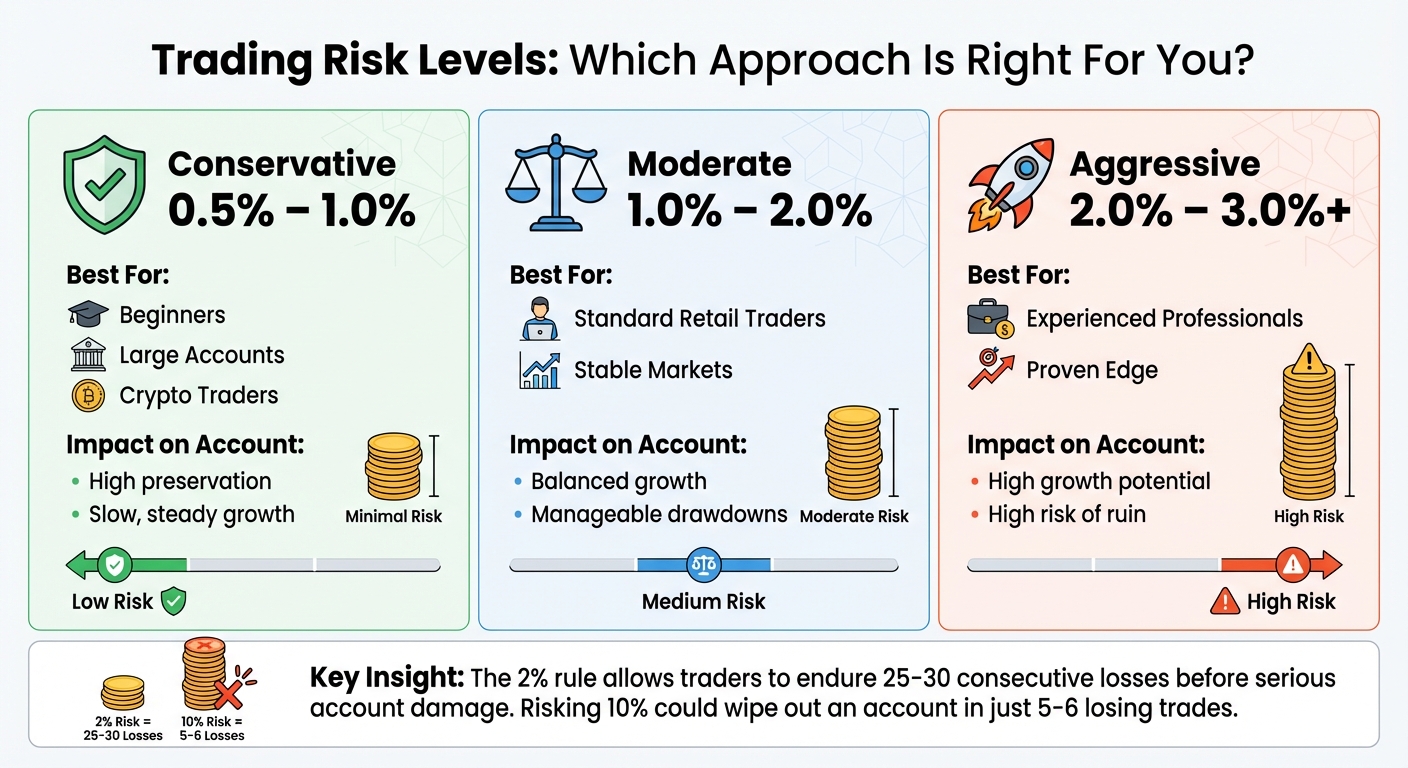
Trading Risk Levels Comparison: Conservative vs Moderate vs Aggressive Position Sizing
Once you understand the basic formula, the next step is deciding on a risk percentage that suits your account size, experience level, and the current market conditions. Many traders stick to the well-known 2% rule, which limits their risk to no more than 2% of their total capital on a single trade. This guideline has stood the test of time because it allows traders to endure about 25 to 30 consecutive losses before their account faces serious damage.
For beginners or those trading in highly volatile markets like cryptocurrency, adopting a more cautious approach is often wiser. Risking just 0.5% to 1% per trade gives you room to learn without putting your account in jeopardy.
On the flip side, experienced traders with proven strategies may choose to take on more risk. For example, they might increase their exposure to 2%–3% or even higher for trades they feel strongly about. While this can boost account growth, it also amplifies potential losses. To put it into perspective, risking 10% of your account on a single trade could wipe you out in as few as 5–6 consecutive losing trades.
Here’s how different risk levels stack up:
| Risk Level | Percentage | Best For | Impact on Account |
|---|---|---|---|
| Conservative | 0.5% – 1.0% | Beginners, large accounts, crypto traders | High preservation; slow, steady growth |
| Moderate | 1.0% – 2.0% | Standard retail traders in stable markets | Balanced growth; manageable drawdowns |
| Aggressive | 2.0% – 3.0%+ | Experienced professionals with proven edge | High growth potential; high risk of ruin |
This table highlights how varying risk levels can influence your trading outcomes and aligns with the earlier discussion on capital exposure.
Another important factor to consider is portfolio heat – your total risk across all open positions. Even if you’re only risking 1% per trade, holding multiple correlated positions (like several tech stocks) could push your overall exposure beyond your comfort zone. In such cases, it’s smart to lower your risk percentage to account for these overlaps.
Up next, we’ll dive into how risk-to-reward ratios can further optimize your position sizing strategies.
How Risk-to-Reward Ratios Affect Position Sizing
What Risk-to-Reward Ratios Mean
The risk-to-reward (R:R) ratio is a way to measure the potential profit of a trade compared to the expected loss. For example, a 1:2 ratio means you’re risking $1 to potentially gain $2, while a 1:3 ratio means risking $1 to gain $3. Many professional traders aim for a minimum ratio of 2:1, which ensures that a single winning trade can offset at least two losing trades. Interestingly, even with a 50% success rate, a strategy using a 2:1 ratio can still be profitable.
The "R" in this equation refers to one unit of risk. So, if you aim for a 3R profit target, you’re looking to earn three times the amount you’re risking. This ratio plays a significant role in position sizing, as it helps define the mathematical edge needed for consistent profitability. Tools like the Kelly Criterion incorporate the R:R ratio and win probability to calculate the optimal amount to risk on each trade. For instance, if you have a 60% win rate and an average win-to-loss ratio of 1.5:1, the Kelly Criterion suggests risking 40% of your capital. However, most traders use a more conservative approach, such as the quarter-Kelly method, which reduces the risk to around 10%.
By understanding these ratios, traders can set realistic profit targets and evaluate whether the potential reward of a trade justifies the risk involved.
Filtering Trades Using Risk-to-Reward Ratios
Smart traders use R:R ratios as a filter to identify worthwhile opportunities. Before committing any capital, they ensure that each trade meets their minimum acceptable ratio – often 1:3 or higher. To do this, calculate the trade’s risk and compare it to your minimum R:R requirement. Once confirmed, determine the number of units to buy by dividing your allowed account risk by the trade’s risk. Trades that fail to meet the minimum ratio are simply avoided.
However, a high R:R ratio alone doesn’t make a trade worthwhile. If the probability of success is too low, even a favorable ratio can lead to poor results over time. Similarly, in volatile markets, tight stop-losses may get triggered by minor price fluctuations, causing trades to fail before reaching their profit targets.
Position Sizing Methods and How to Apply Them
3 Main Position Sizing Methods
Fixed Percentage (Fixed Fractional) Sizing is one of the most commonly used strategies among retail traders. With this method, you risk a predetermined percentage of your total capital on every trade – usually between 1% and 2%. For instance, if your trading account is $50,000 and you stick to the 2% rule, you would risk $1,000 per trade. As your account balance grows, the dollar amount you risk increases, allowing for compounding gains. On the flip side, during losing streaks, your risk automatically decreases, helping to protect your capital from significant losses.
Risk Multiple (Fixed Dollar) Sizing involves setting a constant dollar amount to risk on every trade. This is often referred to as the "R" factor. For example, if you decide that 1R equals $500, you would risk exactly $500 on every trade. This approach offers precise control over your potential dollar losses, making it appealing to beginners or traders with fixed income goals. However, it doesn’t scale with account size. For example, risking $500 might represent 5% of a $10,000 account but only 1% of a $50,000 account, which can impact your overall risk management.
Volatility-Based Sizing adjusts your position size based on market volatility, often measured using the Average True Range (ATR) indicator. The idea is straightforward: highly volatile assets with wider ATR values receive smaller position sizes, while more stable assets with narrower ATR values allow for larger positions. This ensures that each trade contributes a consistent level of risk to your portfolio. This method is especially popular among algorithmic traders who manage diverse portfolios across different asset classes, as it helps maintain balanced risk exposure despite varying asset behaviors.
Now let’s look at how to apply these methods step by step.
Step-by-Step Position Sizing Process
Once you’ve chosen a position sizing method, here’s a clear process to calculate your position size for any trade.
1. Set your account risk limit. Decide on the percentage of your account you’re willing to risk per trade. For example, in a $25,000 account, a 2% risk limit means your maximum loss per trade would be $500. Adjust this percentage based on market conditions – use a lower percentage for volatile markets and a slightly higher one for more stable conditions.
2. Determine your trade risk. Identify the point at which your trade would be invalidated, typically set by your stop-loss level. For instance, if you buy a stock at $50 and place your stop-loss at $45, your risk per share is $5.
3. Calculate your position size. Use the following formula to find the number of shares or contracts to trade:
Position Size = (Account Balance × Risk %) / (Entry Price – Stop Loss Price).
For a $25,000 account with a 2% risk limit and a $5 risk per share, your position size would be 100 shares. Always account for transaction fees and slippage to keep your risk within acceptable limits. For high-risk scenarios, such as earnings announcements, consider reducing your position size – perhaps by half – to avoid the impact of price gaps that can exceed your stop-loss level overnight.
sbb-itb-e64548c
Position Sizing Mistakes to Avoid
Even seasoned traders can stumble into position sizing missteps that can severely impact their account balance. Being aware of these common pitfalls is crucial to staying disciplined, especially when the market challenges your emotions and strategies.
Overconfidence and Taking Too Much Risk
A streak of wins can sometimes lure even experienced traders into abandoning their risk management rules. When confidence soars, it’s tempting to increase position sizes based on gut feelings rather than sticking to a systematic plan. However, research consistently shows that sticking to a structured sizing approach beats relying on intuition, often leading to better long-term performance.
It’s also vital to adjust your risk exposure based on the volatility of the asset you’re trading. For example, risking 2% of your account on a steady stock like McDonald’s is not the same as risking 2% on a highly volatile asset like Bitcoin. Without factoring in volatility, you could unintentionally expose yourself to much higher risks.
Emotions often sneak in, too. If you feel overly anxious or euphoric about a trade, it could be a sign that your position size is too large. This emotional imbalance can cloud your judgment, leading to impulsive decisions like revenge trading or overtrading, which can quickly drain your capital.
Another factor that often goes unnoticed is the impact of trading costs, which we’ll dive into next.
Forgetting Trading Costs and Slippage
Ignoring trading costs is another way traders unintentionally sabotage their risk management. Commissions, spreads, and slippage might seem minor, but they can quietly push your actual risk beyond the planned percentage, such as 1%. Over time, this discrepancy can snowball, eating into your profits.
Slippage is especially troublesome when trading low-liquidity assets or during volatile market conditions. For instance, stop-loss orders turn into market orders when triggered, but there’s no guarantee you’ll get filled at your chosen price. Events like earnings reports or overnight price gaps can cause prices to skip past your stop-loss level, leading to losses that exceed your intended risk. To combat this, experienced traders often add a slippage buffer based on past data and round down their position sizes to avoid over-leveraging.
"To properly exercise this model, you’ll also need to take into account the fees you’re going to pay. Also, you should think about potential slippage, especially if you’re trading a lower liquidity instrument." – Binance Academy
Adjusting Position Sizing for Different Market Conditions
Markets are always changing, and so does their behavior. When volatility rises, sticking to position sizes designed for calmer periods can expose you to unnecessary risk. The smart move? Adjust your position size based on volatility. As price swings grow larger, scaling down your positions helps keep your dollar risk steady.
One tool traders rely on is the Average True Range (ATR), which measures an asset’s typical price movement. If ATR increases, it indicates the need for wider stop-loss levels. To keep your risk consistent – say, 1% of a $100,000 account – you would trade fewer shares or contracts when volatility is high. This is a common practice among professional traders, who tweak their position sizing based on the current volatility environment.
Experienced traders often categorize market conditions into distinct volatility levels: low, moderate, high, and extreme. For example, when ATR surpasses 3% of an asset’s price, many reduce their leverage to 1:1 or even avoid trading that asset altogether. Similarly, during events like earnings announcements or major economic updates, traders frequently cut their position size in half to account for gap risk – those sudden price jumps that can bypass stop-loss orders overnight.
This volatility-driven approach ties directly into earlier position sizing formulas. The calculation looks like this:
Position Size = Total Account Risk ÷ Volatility-Adjusted Stop-Loss Distance.
Here’s a practical example: Let’s say your ATR-based stop-loss is $5 away from your entry price, and you’re risking $1,000. In this case, you could trade 200 shares. But if volatility doubles, pushing the stop-loss to $10, you’d only trade 100 shares. This disciplined method ensures that one wild price swing doesn’t wipe out weeks of hard-earned gains.
Tools for Automating Position Sizing Calculations
Calculating position sizes manually can be time-consuming and error-prone. Thankfully, most modern trading platforms have automated this process. These systems use mathematical formulas and algorithms to adjust trade sizes based on your risk preferences, current market conditions, and portfolio dynamics. By automating these calculations, traders can eliminate emotional decision-making and consistently adhere to their risk management rules. This automation also paves the way for more advanced strategy testing and execution.
Today’s backtesting software allows traders to experiment with various position sizing methods before applying them in live markets. For example, MillionMachine offers a user-friendly interface where you can design strategies, refine position sizing rules, and test them across multiple asset classes – all without needing to write any code. The platform’s Monte Carlo simulations are particularly useful for evaluating how different sizing techniques perform under various market conditions, helping identify potential weaknesses. You can compare fixed fractional sizing with volatility-adjusted methods to determine which approach offers better risk-adjusted returns for your specific trading strategy.
Many professional trading platforms also integrate directly with broker APIs, ensuring that your trades align with calculated risk parameters. These tools actively monitor account equity, open positions, and market volatility indicators like ATR (Average True Range) to adjust position sizes as conditions change. Advanced features like tracking "portfolio heat" (total risk exposure across all positions) help prevent overexposure to any single asset or strategy. This integration ensures that accurate position sizing translates seamlessly into real-time market execution.
To refine your approach, consider using walk-forward analysis on out-of-sample data. Starting with simple fixed-percentage methods can be a good foundation before moving on to more complex approaches like volatility scaling or risk-parity sizing.
Important Disclosures About MillionMachine
MillionMachine.com is a software platform designed for research, education, and strategy development. It does not offer personalized investment, trading, or financial advice, nor does it solicit the purchase or sale of any financial instruments. The platform does not provide recommendations on the suitability of any trading strategy or investment.
Users are solely responsible for evaluating their trading decisions and the associated risks. All simulations, backtests, and performance metrics generated by MillionMachine are hypothetical and should not be interpreted as guarantees of future performance. Hypothetical results come with inherent limitations and may differ significantly from actual trading outcomes.
MillionMachine is not registered as a Commodity Trading Advisor (CTA), Investment Advisor, or Broker-Dealer with the NFA, CFTC, SEC, or any other regulatory authority. While the platform’s founder was formerly registered as a CTA with the National Futures Association (NFA), that registration is no longer active. MillionMachine does not engage in any activities regulated by these authorities.
The platform does not execute trades, handle customer funds, or provide access to real-time trading accounts. Any integration with broker APIs is strictly for user-initiated automation, and users are fully responsible for ensuring compliance with applicable laws, regulations, and broker requirements.
All market data, charts, signals, and analytics provided by MillionMachine are for educational and informational purposes only. MillionMachine does not verify the accuracy or completeness of the data and assumes no liability for errors, delays, or omissions.
Trading financial instruments, including futures, stocks, cryptocurrencies, and derivatives, involves substantial risks and may not be suitable for all investors. Losses can exceed your initial investment. Past performance – whether actual or simulated – is not indicative of future results.
Conclusion
Position sizing is a cornerstone of disciplined trading. It transforms risk management principles into actionable decisions, determining exactly how much of your capital to allocate to each trade. Brijesh Bhatia, Equity Capital Market Analyst at Definedge, puts it perfectly:
"Position sizing is the glue that holds together a sound trading system. It ensures you don’t over-leverage or under-commit in any single trade, helping you stay in the game long enough to let your edge play out over a series of trades."
A 13-year study of roughly 200 equity managers found that sizing decisions accounted for 60% of outperformance compared to an equally weighted portfolio. This highlights just how crucial it is to establish clear, practical rules that keep your trading methodical and disciplined.
Start by capping your risk at 1–2% per trade, setting stop-loss levels in advance, and adjusting for market volatility (e.g., using the Average True Range). Keep an eye on your overall portfolio risk and maintain a trading journal to refine your approach over time.
Moving from emotional to systematic position sizing not only removes bias but also reinforces consistent risk management, allowing your edge to grow over the long term. Whether you trade stocks, futures, or cryptocurrencies, proper position sizing safeguards your capital during losses and helps your gains compound over hundreds of trades. Stick to these principles to build a foundation for sustained trading success.
MillionMachine.com is a software tool designed for research, education, and strategy development. Nothing on this website or within the MillionMachine platform should be interpreted as personalized investment advice, trading advice, financial advice, or a solicitation to buy or sell any financial instrument. MillionMachine does not offer recommendations or guidance on the suitability of any strategy, trade, or investment.
Users are fully responsible for evaluating their own trading decisions and risks. All simulations, backtests, performance metrics, and analytics provided by MillionMachine are purely hypothetical and are not guarantees of future performance. Hypothetical results have inherent limitations and do not reflect actual trading outcomes. Real-world results may differ significantly from simulated scenarios.
MillionMachine is not registered as a Commodity Trading Advisor (CTA), Investment Advisor, or Broker-Dealer with the NFA, CFTC, SEC, or any other regulatory body. While the founder was previously registered as a CTA with the National Futures Association (NFA), that registration is no longer active, and MillionMachine does not engage in any regulated advisory activities.
MillionMachine does not execute trades, handle customer funds, or provide access to live trading accounts. Any integration with broker APIs is solely for user-initiated, user-controlled automation. Users are responsible for ensuring their trading activities comply with all applicable laws, regulations, and broker requirements.
All market data, charts, derived signals, and analytics displayed by MillionMachine are provided for informational and educational purposes only. MillionMachine does not verify the accuracy or completeness of market data and assumes no responsibility for errors, delays, or omissions.
Trading financial instruments, including futures, stocks, cryptocurrencies, and derivatives, involves substantial risk and may not suit all investors. Losses can exceed your initial investment. Past performance, whether actual or simulated, is not indicative of future results.
FAQs
Why is position sizing crucial for long-term trading success?
Position sizing is a key element in managing risk and maintaining steady profitability in trading. By controlling how much capital you allocate to each trade, you can safeguard your portfolio during losing streaks while still leaving room for growth when trades go your way.
This strategy not only helps protect your capital but also minimizes the effects of drawdowns and enhances your overall returns relative to the risks you take. A disciplined approach to position sizing is especially crucial for sustaining success over the long haul, particularly when using algorithmic trading strategies.
How does market volatility affect position sizing in trading?
Market volatility is a crucial factor in deciding position sizes because it helps maintain consistent risk management. When markets are more volatile, traders usually reduce position sizes to minimize potential losses. On the flip side, when volatility is lower, traders can take on larger positions while keeping the same level of risk per trade.
This method allows your trading strategy to adjust to shifting market conditions. It helps safeguard your capital during unpredictable times and makes the most of opportunities when the market is more stable.
Why should position sizing be adjusted based on the risk-to-reward ratio?
Adjusting your position size according to the risk-to-reward ratio is a smart way to manage your capital. By taking larger positions on trades that offer higher potential rewards with lower risks, you can fine-tune your overall performance while steering clear of setups that carry unnecessary exposure.
This method keeps your trading strategy aligned with your risk tolerance and long-term objectives. It promotes consistency and helps you keep losses in check – an essential part of maintaining discipline in trading.

