
When optimizing trading strategies, Grid Search and Random Search are two key methods for fine-tuning parameters like RSI thresholds or moving average lengths. Here’s the gist:
- Grid Search tests all parameter combinations systematically, ensuring thorough exploration but requiring significant computational resources.
- Random Search selects random combinations, offering faster results and broader coverage of possibilities, especially for complex strategies with many parameters.
Key Takeaways:
- Use Grid Search for fewer parameters and when thorough, reproducible testing is required.
- Opt for Random Search when working with many parameters or limited computational power.
Quick Comparison
| Factor | Grid Search | Random Search |
|---|---|---|
| Approach | Tests all combinations systematically | Randomly samples parameter values |
| Speed | Slower; grows exponentially with parameters | Faster; fewer combinations tested |
| Coverage | Limited to predefined grid points | Explores broader parameter space |
| Best For | Small parameter sets | High-dimensional problems |
| Reproducibility | High | Lower without a fixed random seed |
Both methods have pros and cons. Your choice depends on the complexity of your strategy and available resources.
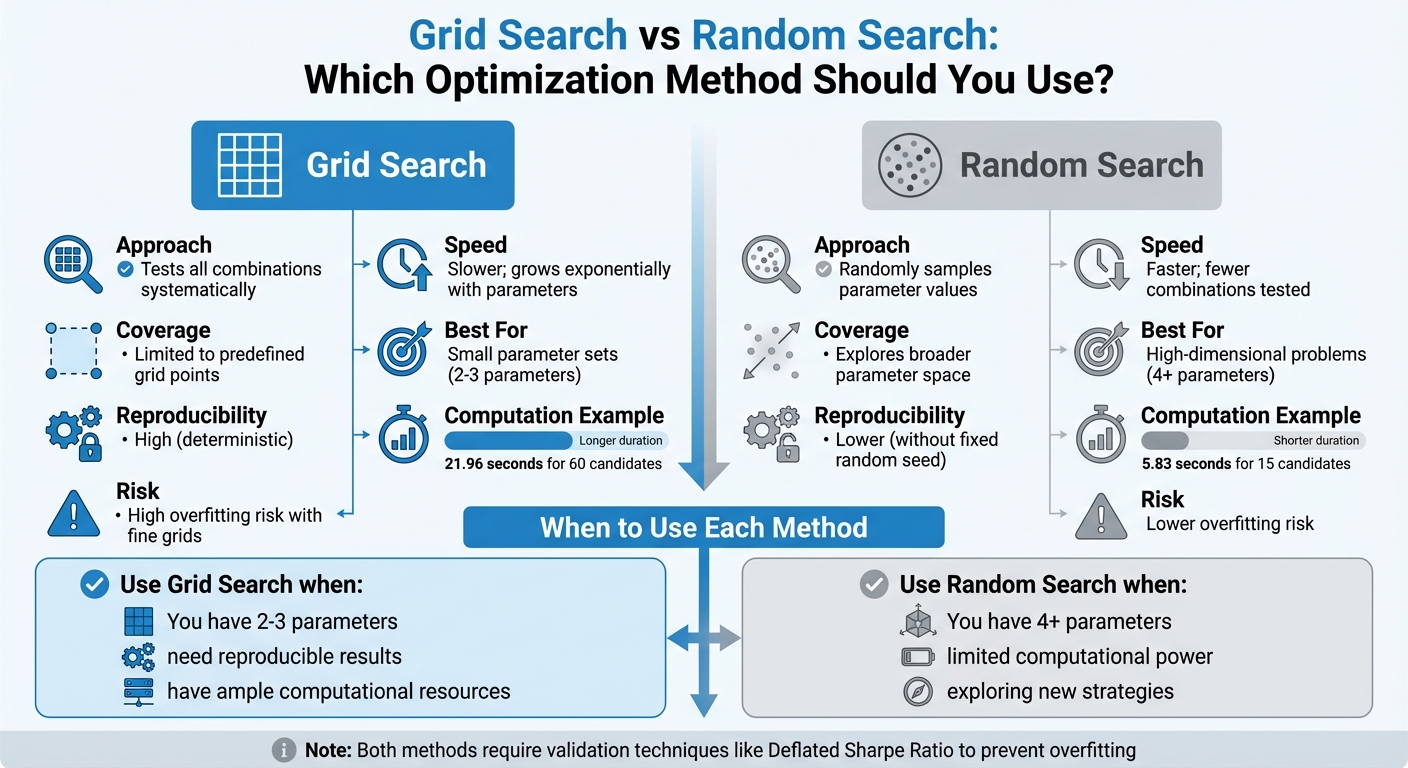
Grid Search vs Random Search: Trading Strategy Optimization Comparison
Grid Search vs. Random Sampling in Strategy Optimization
What is Grid Search?
Grid Search takes a methodical approach by testing every possible combination of predefined parameters for a trading strategy. Imagine a multi-dimensional grid where each axis represents a specific parameter – like a moving average length or an RSI threshold – and each point on the grid corresponds to a unique combination of these parameters. Each of these combinations is then backtested to evaluate its performance. This approach is deterministic, meaning the results can be consistently reproduced.
How Grid Search Works
Here’s how the Grid Search process unfolds:
- Parameter Selection: Decide which parameters of the trading strategy to fine-tune, such as stop-loss percentages, indicator thresholds, or window lengths.
- Range Definition: Set the range and increments for each parameter. For example, you might test RSI thresholds at 55, 65, 75, and 85.
- Combination Generation: Create all possible combinations. For instance, if parameter A has 3 values and parameter B has 3 values, you’ll end up with 9 combinations.
- Backtesting: Run the trading strategy on historical market data for each combination.
- Evaluation: Analyze the performance of each combination using metrics like the Sharpe ratio, Sortino ratio, total returns, and maximum drawdown.
- Selection: Choose the parameter set that best aligns with your trading objectives.
For example, in 2022, Trading Strategy applied Grid Search to a Bollinger Band and RSI strategy for WAVAX/USDC. They tested 48 combinations and found optimal parameters that yielded a 19.76% annualized return, compared to a -31.66% return with poorly tuned settings.
Grid Search Advantages
Grid Search is thorough – it evaluates every combination within the defined parameter space, leaving no stone unturned. This makes it particularly useful for strategies with a small number of parameters. As Trading Strategy highlights:
"Grid searching allows for a comprehensive evaluation of performance metrics and helps identify the parameter configuration that maximises returns."
Another benefit of Grid Search is its systematic nature, which ensures consistent results. Plus, since each parameter combination is independent, you can speed up the process by running multiple backtests simultaneously using parallel processing.
Grid Search Limitations
The biggest downside of Grid Search is its heavy computational demand. The number of tests grows exponentially with the number of parameters. For instance, if two parameters each have 3 values, you’d need to test 9 combinations. But add a third parameter with 10 values, and suddenly you’re running 90 tests. This rapid growth, often called the "curse of dimensionality", can make Grid Search unmanageable for strategies with many variables.
Another risk is overfitting. Testing thousands of combinations increases the chance of finding a parameter set that performs well purely due to random noise, rather than offering a genuine edge. As Marcos Lopez de Prado, author of Advances in Financial Machine Learning, cautions:
"Every backtest result must be reported in conjunction with all the trails involved in its production. Absent that information, it is impossible to assess the backtest’s ‘false discovery’ probability."
For example, a 2022 study on momentum strategies for the S&P 500 used Grid Search to test 7,000 parameter combinations. While the top Sharpe Ratio was 0.827, adjusting for multiple testing with the Deflated Sharpe Ratio (DSR) revealed that the results were statistically indistinguishable from random outcomes.
To address these challenges, many traders take a two-step approach. They start with a broad search using large increments to identify promising regions. Then, they narrow the focus and conduct a finer search within those areas to pinpoint optimal values. Another practical solution is result caching, where backtest results are saved to disk. This way, if the process is interrupted, it can resume without starting over.
Next up, we’ll explore Random Search, an alternative method designed to tackle some of these challenges.
What is Random Search?
Random Search is a method that picks parameter combinations randomly from specified ranges, evaluating a set number of candidates (like 20 or 50) to measure performance. Unlike Grid Search, which systematically tests every combination, Random Search avoids the steep computational costs that come with exploring all possibilities.
The standout benefit here is efficiency. Research by Bergstra and Bengio highlights that Random Search can produce results comparable to Grid Search. For example, a benchmark using Scikit-learn showed that a randomized search took only 19.80 seconds to evaluate 20 candidates, while a grid search needed 113.86 seconds to test 100 candidates across the same parameter space. This time-saving aspect makes Random Search particularly appealing for traders working with limited computing power or tight deadlines.
Random Search is especially effective when only a few parameters significantly impact performance. Bergstra and Bengio explain:
"For most data sets only a few of the hyper-parameters really matter, but that different hyper-parameters are important on different data sets. This phenomenon makes grid search a poor choice for configuring algorithms for new data sets."
Since Random Search samples from all parameter dimensions, it tends to explore a wider variety of values compared to Grid Search, which might repeatedly test the same predefined points.
How Random Search Works
Here’s a practical breakdown of how Random Search operates:
- Define the search space: Specify continuous ranges for each parameter. For instance, set the moving average period between 10 and 200, or the RSI range from 20 to 80.
- Set the number of iterations: Determine how many combinations to test based on your computational resources.
- Random sampling: The algorithm randomly selects parameter combinations from the defined ranges.
- Run backtests: Evaluate each combination on historical market data.
- Assess performance: Use metrics like the Sharpe ratio, Sortino ratio, or maximum drawdown to identify the best-performing parameter set.
For parameters spanning multiple orders of magnitude – like volatility thresholds – a log-uniform distribution can help ensure the entire range is covered effectively.
Random Search Advantages
One of Random Search’s biggest strengths is its ability to handle high-dimensional spaces efficiently. You can control the number of tests regardless of how many parameters you’re working with, making it ideal for strategies involving numerous variables.
Another advantage is its flexibility in exploration. Unlike Grid Search, which is limited to predefined grid points, Random Search can identify optimal values that fall between those points. This adaptability is particularly useful when you’re unsure of the exact parameter ranges to target.
Additionally, Random Search allows you to align your testing directly with your computational budget. For instance, if you only have 50 hours available, you can configure the search to run exactly 50 iterations.
Random Search Limitations
Despite its benefits, Random Search does have some drawbacks. One issue is uncertainty – random sampling might overlook the optimal parameter combination. While increasing the number of iterations reduces this risk, it doesn’t eliminate it entirely.
Another challenge is inconsistent results. Without setting a random seed, running the same search multiple times can yield different outcomes, making it less reproducible compared to the deterministic results of Grid Search.
Finally, there’s the risk of overfitting. Testing numerous random combinations might lead to selecting parameters that perform well by chance rather than genuine predictive ability. To mitigate this, traders should use validation techniques and metrics like the Deflated Sharpe Ratio to account for the number of trials conducted.
Next, we’ll compare Random Search and Grid Search to better understand their specific use cases.
Grid Search vs Random Search: Direct Comparison
When applied to real-world trading scenarios, the differences between Grid Search and Random Search become especially apparent in terms of computational efficiency and how well they explore parameter space.
Benchmarks consistently reveal that Random Search is significantly faster while delivering comparable performance. For example, one test with a linear SVM showed Random Search evaluating 15 candidates in just 5.83 seconds, whereas Grid Search took 21.96 seconds to test 60 candidates – about four times longer – for similar validation scores. Another test highlighted Random Search completing 20 evaluations in 19.80 seconds, while Grid Search required 113.86 seconds for 100 evaluations. This demonstrates a clear efficiency advantage for Random Search, with only minimal trade-offs in performance.
Grid Search often wastes computational power by testing every possible combination, including many that have little to no impact on performance. On the other hand, Random Search focuses more on key dimensions, sampling points that matter most and ignoring less relevant ones. These differences in performance and efficiency are summarized in the table below.
Comparison Table
| Factor | Grid Search | Random Search |
|---|---|---|
| Testing Approach | Systematic and exhaustive; evaluates all predefined combinations | Stochastic; samples parameter combinations from a probability distribution |
| Computation Time | High; grows exponentially with the number of parameters | Low; achieves similar performance in much less time |
| Parameter Space Coverage | Limited to predefined grid points, potentially missing optimal values | Broader; explores more configurations |
| Handling Multiple Parameters | Resource-intensive as parameter count increases | Efficient even in high-dimensional spaces |
| Reproducibility | High; identical results every time | Lower; results vary unless a fixed random seed is used |
| Implementation | Straightforward and easy to understand | Requires defining probability distributions |
| Risk of Overfitting | High if the grid is too fine | Lower; avoids over-tuning to noise |
This side-by-side comparison shows that the choice between Grid Search and Random Search depends on your specific needs, including the complexity of your parameter space and the computing resources at your disposal.
sbb-itb-e64548c
When to Use Each Method
Deciding between Grid Search and Random Search boils down to the number of parameters you’re working with and the computing resources you have. Grid Search works well for fewer parameters and ample computational power, while Random Search shines when you have many parameters or limited resources. Let’s break it down further.
When to Use Grid Search
Grid Search is ideal for straightforward, reproducible strategies involving one to three parameters. It’s especially useful once you’ve identified promising regions through initial testing. For instance, if you’re optimizing a moving average crossover strategy with two parameters – a short-period and a long-period moving average – Grid Search can systematically test all possible combinations within a manageable timeframe.
One of the key advantages of Grid Search is its consistency. It always tests the same predefined points, ensuring reproducibility. This makes it a go-to choice when you need to document your process or share results. A common approach is to start with a coarse grid to identify areas of good performance, then refine with a finer grid to zero in on the best values. However, as the number of parameters increases, the complexity grows exponentially, making Grid Search less practical for more intricate strategies. In such cases, Random Search may be a better fit.
When to Use Random Search
Random Search is your best bet when dealing with four or more parameters or when computational power is limited. Research by James Bergstra and Yoshua Bengio highlights its efficiency:
"randomly chosen trials are more efficient for hyper-parameter optimization than trials on a grid"
Unlike Grid Search, Random Search explores a wider range of values across parameters. This is particularly useful in trading strategies, where only a few parameters often have a major impact on performance. Random sampling increases the chances of hitting those critical values compared to the rigid structure of Grid Search.
Random Search is especially helpful in the early stages of strategy development when you’re unsure which parameters matter most. It allows for a quick exploration of the parameter space without requiring extensive resources. Once you identify promising regions, you can refine your search with a focused Grid Search to fine-tune the results. This makes Random Search a practical starting point when you’re working with tight computational budgets or need faster results.
Both methods have their strengths, and the choice depends on the complexity of your strategy and the resources at your disposal.
Parameter Optimization on MillionMachine

MillionMachine takes the complexity of parameter optimization and makes it accessible through a visual, no-code platform. By incorporating Grid Search and Random Search, it allows traders to refine their strategies without needing to write intricate algorithms. The platform creates a multidimensional grid where each axis represents a parameter – like moving average lengths or RSI thresholds – and tests combinations against historical data. This streamlined approach caters to both beginners and seasoned traders, enabling them to implement advanced optimization techniques with ease.
Visual Strategy Design and Optimization
The platform’s optimization process involves defining a parameter grid, generating combinations, evaluating each setup, and identifying the best configuration based on performance metrics. Users can adjust the granularity of parameter exploration to suit their needs. It also supports randomized grid searches, which test a subset of combinations and can often pinpoint optimal setups faster than exhaustive methods.
MillionMachine employs parallel processing through thread pools to run multiple backtests simultaneously, speeding up the optimization process. A caching system ensures that interrupted optimizations can resume without losing progress. Results are presented visually with tools like 2D heatmaps, where dark blue regions highlight high-profit zones, making it easier to identify stable parameter ranges instead of relying on isolated peaks. Additionally, detailed tables provide insights into at least six metrics, such as Annualized Return, Max Drawdown, Sharpe Ratio, and Sortino Ratio for every combination tested.
Overfitting Prevention Tools
To address the risk of overfitting, MillionMachine incorporates Monte Carlo simulations. These simulations test strategies across varied synthetic price paths to evaluate their sensitivity to historical noise. The platform also supports the Deflated Sharpe Ratio (DSR), which helps correct for selection bias and false positives that can arise from multiple trials. Sensitivity analysis further ensures reliability by testing how small parameter adjustments affect performance – stable strategies retain consistent results even with minor tweaks. These measures provide traders with greater confidence when applying strategies in real-world markets.
Multi-Asset Class Support
MillionMachine supports optimization across a wide range of asset classes, including stocks, futures, currencies, ETFs, and cryptocurrencies. It’s designed to handle complex strategies involving thousands of trading pairs, including blockchain-based pairs like WAVAX/USDC, as well as traditional equity markets. This versatility ensures that the same powerful tools can be applied across different markets, reinforcing the platform’s focus on effective strategy optimization.
MillionMachine.com is intended for research, education, and strategy development only. Nothing on the platform or website should be interpreted as personalized investment advice, trading advice, financial advice, or a solicitation to buy or sell financial instruments. MillionMachine does not provide recommendations or guidance on the suitability of any strategy, trade, or investment.
Users are fully responsible for evaluating their trading decisions and risks. All simulations, backtests, and performance metrics generated by MillionMachine are hypothetical and are not guarantees of future results. Hypothetical performance comes with inherent limitations and does not reflect actual trading. Actual results may vary significantly from simulations.
MillionMachine is not registered as a Commodity Trading Advisor (CTA), Investment Advisor, or Broker-Dealer with the NFA, CFTC, SEC, or any other regulatory authority. While its founder was previously registered as a CTA with the National Futures Association (NFA), that registration is no longer active, and MillionMachine does not engage in regulated advisory activities.
The platform does not execute trades, handle customer funds, or provide access to real-time trading accounts. Any integration with broker APIs is solely for user-initiated automation. Users are responsible for ensuring compliance with all applicable laws, regulations, and broker requirements.
All market data, charts, signals, and analytics provided by MillionMachine are for informational and educational purposes only. MillionMachine does not guarantee the accuracy or completeness of market data and assumes no responsibility for errors, delays, or omissions.
Trading financial instruments – including futures, stocks, cryptocurrencies, and derivatives – carries significant risks and may not be suitable for all investors. Losses can exceed the initial investment. Past performance, whether actual or simulated, is not indicative of future results.
Conclusion
Key Takeaways
Deciding whether to use Grid Search or Random Search comes down to the number of parameters you’re working with and the computational resources at your disposal. Grid Search is ideal for situations where you’re focusing on 2–3 parameters and want a methodical, exhaustive approach to evaluate every possible combination. It’s particularly useful for fine-tuning after identifying a promising parameter range through preliminary testing.
On the other hand, Random Search thrives in scenarios involving a high number of variables. Research by James Bergstra and Yoshua Bengio highlights its efficiency:
"Randomly chosen trials are more efficient for hyper-parameter optimization than trials on a grid".
Random Search often delivers results faster, as benchmarks show it can achieve similar outcomes in much less time. This speed matters because, in most strategies, only a handful of hyperparameters significantly influence performance.
However, both methods come with the risk of overfitting. Grid Search can overfit when testing thousands of combinations, making it essential to validate results using metrics like the Deflated Sharpe Ratio to separate genuine performance improvements from statistical noise. While Random Search lowers the risk by testing fewer combinations, it might miss the absolute best configuration if the number of iterations is too limited.
These two approaches are the foundation of the optimization tools provided by MillionMachine.
Final Thoughts on MillionMachine
MillionMachine builds on these optimization methods with a user-friendly, no-code platform that supports both Grid Search and Random Search. The platform simplifies the process with features like parallel processing, result caching, and 2D heatmaps to help identify stable parameter ranges. It also includes built-in tools to address overfitting, such as Monte Carlo simulations and Deflated Sharpe Ratio calculations.
By turning raw parameter searches into actionable insights, MillionMachine equips users to make smarter, data-driven optimization decisions for trading strategies across stocks, futures, and cryptocurrencies – all while minimizing computational complexity.
MillionMachine.com is designed as a research and educational tool. It is not intended to provide personalized investment advice, trading recommendations, or financial guidance. The platform does not solicit the purchase or sale of any financial instrument, nor does it assess the suitability of any strategy or investment for individual users.
Users are fully responsible for their own trading decisions and the associated risks. Any simulations, backtests, or performance metrics generated by MillionMachine are purely hypothetical and carry inherent limitations. They do not guarantee future results, and actual outcomes may vary significantly from simulated ones.
MillionMachine is not registered as a Commodity Trading Advisor (CTA), Investment Advisor, or Broker-Dealer with the NFA, CFTC, SEC, or any other regulatory body. Although the founder was previously registered as a CTA with the National Futures Association (NFA), that registration is no longer active, and MillionMachine does not engage in any regulated advisory activities.
The platform does not execute trades, manage customer funds, or provide access to live trading accounts. Any integration with broker APIs is solely for user-initiated automation, with users maintaining full responsibility for compliance with applicable laws, regulations, and broker requirements.
All market data, charts, signals, and analytics displayed by MillionMachine are provided for informational and educational purposes. MillionMachine does not guarantee the accuracy or completeness of the data and is not liable for any errors, delays, or omissions.
Trading financial instruments – including futures, stocks, cryptocurrencies, and derivatives – carries substantial risks and may not be suitable for all investors. Losses can exceed your initial investment. Past performance, whether actual or simulated, is not a reliable indicator of future results.
FAQs
What’s the difference between Grid Search and Random Search for optimizing trading strategies?
When it comes to fine-tuning trading strategy parameters, Grid Search and Random Search are two widely used methods. Choosing between them largely hinges on your specific goals and the resources you have available.
Grid Search works by systematically testing every possible combination of predefined parameter values. It’s a solid choice if you’re dealing with a limited number of parameters (ideally 3–4 or fewer) and have a clear idea of their potential ranges. While this method guarantees a thorough examination, it can quickly become resource-intensive as the number of parameters increases.
Random Search, in contrast, takes a more flexible approach by randomly sampling parameter combinations within the given ranges. This method is particularly useful for exploring larger or more complex parameter spaces, especially when you’re uncertain about which parameters have the most influence. Research suggests that Random Search often identifies strong results faster than Grid Search, making it a practical choice when time or computational power is constrained.
For a balanced approach, you can combine the two: use Random Search to pinpoint promising regions of the parameter space, then apply Grid Search for fine-tuning. Regardless of the method you choose, always validate your results through out-of-sample testing and use overfitting checks to ensure your strategy performs reliably.
What are the risks of overfitting when optimizing parameters with Grid Search or Random Search?
When it comes to parameter optimization, both grid search and random search have their limitations, particularly the risk of overfitting. Grid search systematically evaluates every possible parameter combination, which can sometimes lead to configurations that fit the noise or quirks of historical data rather than genuine patterns. This often inflates in-sample metrics like return or Sharpe ratio, but those same configurations may fall short when applied to new, unseen data. Random search, while less exhaustive, isn’t immune to overfitting either, especially if the same dataset is repeatedly used without proper safeguards.
To tackle these challenges, it’s essential to keep the data used for parameter tuning separate from the data used for evaluating performance. Techniques like out-of-sample testing, cross-validation, or walk-forward analysis can help ensure that the chosen parameters remain effective on unseen data. Tools from platforms like MillionMachine can also assist by offering automated out-of-sample reports and overfitting detection, giving traders a clearer picture of their strategy’s robustness.
Is Random Search faster and more effective than Grid Search for optimizing trading strategy parameters?
Random Search often proves quicker than Grid Search in finding effective parameter combinations, particularly when dealing with large parameter spaces where only a handful of variables significantly influence performance. Instead of exhaustively testing every combination, Random Search samples parameters randomly, covering a wide range with fewer computations. This makes it especially practical for tasks like backtesting trading strategies, where each parameter combination may require lengthy historical simulations.
Grid Search, by contrast, systematically evaluates every possible combination within a predefined grid. This method is better suited for smaller parameter spaces or situations where thorough coverage is essential. MillionMachine supports both approaches, giving users the flexibility to choose based on their specific time limits and optimization goals.
MillionMachine.com is a tool designed solely for research, education, and strategy development. Nothing on the website or within the platform should be interpreted as personalized investment advice, trading advice, financial advice, or a solicitation to buy or sell any financial instrument. MillionMachine does not offer recommendations or guidance on the suitability of any strategy, trade, or investment.
Users are fully responsible for assessing their own trading decisions and associated risks. All simulations, backtests, performance metrics, and analytics provided by MillionMachine are hypothetical and should not be viewed as guarantees of future results. Hypothetical performance has inherent limitations and does not reflect actual trading outcomes, which may differ significantly.
MillionMachine is not registered as a Commodity Trading Advisor (CTA), Investment Advisor, or Broker-Dealer with the NFA, CFTC, SEC, or any other regulatory body. While the founder was previously registered as a CTA with the National Futures Association (NFA), that registration is no longer active, and MillionMachine does not engage in regulated advisory activities.
MillionMachine does not execute trades, manage customer funds, or provide access to real-time trading accounts. Broker API integrations, if available, are for user-initiated and user-controlled automation only. Users bear full responsibility for ensuring their trading activities comply with applicable laws, regulations, and broker requirements.
All market data, charts, derived signals, and analytics displayed by MillionMachine are intended for informational and educational purposes. MillionMachine does not verify the accuracy or completeness of market data and assumes no responsibility for errors, delays, or omissions.
Trading financial instruments – including futures, stocks, cryptocurrencies, and derivatives – carries significant risks and may not be suitable for all investors. Losses can exceed the initial investment. Past performance, whether actual or simulated, is not indicative of future results.
By using MillionMachine.com, you acknowledge and accept full responsibility for your investment decisions. MillionMachine, its creators, and affiliates are not liable for any losses, damages, or trading outcomes resulting from your use of the platform.

