
Algorithmic trading accounts for over 32.3% of U.S. trading volume, making compliance automation a necessity in this fast-paced industry. Automated systems ensure trades meet regulatory standards, reduce risks, and avoid costly penalties. Key features include real-time monitoring, pre-trade risk controls, and detailed audit trails, all designed to handle the speed and complexity of modern markets.
Why It Matters:
- Regulatory Pressure: Compliance is mandatory under rules like SEC’s Rule 15c3-5 and MiFID II in Europe.
- Financial Risks: Non-compliance can result in fines, reputational damage, and even exclusion from trading venues.
- Automation Benefits: Systems like kill switches, stress tests, and surveillance tools protect firms from errors and market abuse.
Key Takeaways:
- Automated compliance tools check order size, price limits, and potential manipulation tactics like spoofing.
- Firms must maintain detailed records and meet audit requirements, including annotated source code for algorithms.
- Costs for building compliant systems range from $50,000 to $250,000+, but the investment reduces long-term risks.
Bottom Line: Compliance automation isn’t optional – it’s a critical shield against regulatory challenges in algorithmic trading.
Carsten Gerner-Beuerle – Algorithmic trading and the limits of securities regulation
Regulatory Requirements for Algorithmic Trading
In the U.S., algorithmic traders must adhere to strict regulations enforced by the SEC and CFTC. These rules are non-negotiable, and failing to comply can result in severe penalties, including fines and potential personal liability for senior executives.
SEC and CFTC Guidelines

The SEC’s Rule 15c3-5, known as the Market Access Rule, requires broker-dealers to implement robust pre-trade risk management controls. These controls are designed to prevent trading errors by enforcing limits on order size, applying price collars, and blocking duplicate orders.
Additionally, Regulation SCI (Systems Compliance and Integrity) mandates that automated systems must be capable of handling twice the daily average trading volume. For firms managing client assets, the Investment Advisers Act imposes several requirements:
- Rule 204-2: Firms must retain algorithm-related communications and trade records for five years, with the first two years readily accessible.
- Rule 206(3)-1: Any performance claims based on backtesting must include clear disclaimers about their hypothetical nature.
Here’s a breakdown of key SEC and FINRA rules:
| SEC/FINRA Rule | Focus Area | Key Requirement |
|---|---|---|
| Rule 15c3-5 | Market Access | Pre-trade risk controls |
| Rule 5210 | Market Integrity | Prevention of spoofing, layering, and self-trades |
| Rule 204-2 | Recordkeeping | Maintain records for 5 years |
| Rule 206(3)-1 | Marketing | Disclaimers for AI/ML and backtested performance |
| Rule 3110 | Supervision | Review of code development and testing protocols |
For those trading futures or commodities, the CFTC requires firms to register as Commodity Trading Advisors (CTAs) or Commodity Pool Operators (CPOs), along with maintaining membership in the National Futures Association (NFA). This process involves detailed disclosure and performance reporting. Registration costs typically range from $15,000 to $40,000, with annual compliance expenses running between $20,000 and $75,000.
The SEC has also identified algorithmic trading, AI-driven investment tools, and "black box" algorithms as top priorities for its 2025 examinations. According to the SEC Division of Examinations:
The SEC has made clear that algorithmic trading, AI-driven investment tools, and automated portfolio management systems are top-tier examination priorities.
During these examinations, firms must provide annotated source code and logic diagrams upon request. Refusing to do so is rarely an option. The SEC also evaluates whether algorithms meet fiduciary standards, especially in cases involving machine learning models.
These stringent requirements highlight the importance of automated risk controls for firms aiming to stay compliant. While these regulations form the backbone of U.S. compliance, companies operating internationally face even greater complexity.
International Regulations
For U.S.-based firms trading globally, compliance doesn’t stop at domestic borders. In Europe, MiFID II (Markets in Financial Instruments Directive II) introduces additional rules. While it shares similarities with U.S. regulations, MiFID II includes unique elements like mandatory "Algo IDs", which allow regulators to trace trading events back to specific code logic. It also requires firms to conduct stress testing and implement emergency "kill switch" capabilities.
A growing global trend is the emphasis on personal accountability. For example, the UK’s FCA Senior Managers Regime holds executives personally responsible for compliance failures within their organizations. This shift means that compliance is not just a corporate obligation – it’s also a personal responsibility for leaders overseeing algorithmic trading operations.
Navigating these overlapping regulations is no small task. Non-compliance in one jurisdiction can have a ripple effect, triggering penalties elsewhere. The complexity and expense of maintaining compliance across multiple regulatory frameworks make automation a necessity in today’s interconnected trading landscape.
Components of Compliance Automation
Effective compliance automation serves as a safeguard against regulatory violations, identifies suspicious activity, and ensures detailed record-keeping for compliance purposes. These elements are the foundation of a well-structured compliance automation strategy.
Pre-Trade Risk Controls
Pre-trade risk controls are designed to stop non-compliant orders before they can even hit the market. These automated systems flag and reject orders that exceed preset thresholds for volume or price or appear clearly erroneous. The most effective systems operate at the firm’s gateway, intercepting problematic orders before they leave the system when a violation is detected. Parameters are fine-tuned automatically, customized to fit the specific needs of each algorithm and asset class. For instance, a high-frequency trading algorithm for equities might have stricter price collar limits compared to a slower futures trading strategy. The Financial Conduct Authority emphasizes the importance of this adaptability:
"It is essential that firms’ controls and key oversight functions, including compliance and risk management, keep pace with the ever-increasing complexity and speed of financial markets and technological advancements".
Real-Time Monitoring and Surveillance
Building on pre-trade controls, real-time monitoring ensures compliance by analyzing market activity as it happens. Once trades are executed, surveillance systems scan high-speed data streams for signs of market abuse, such as quote stuffing (flooding the market with rapid orders), layering (creating deceptive market activity), spoofing, or "painting the tape". These systems also track metrics like the ratio of unexecuted orders to completed transactions and can throttle order flow if system capacity becomes strained.
Many firms are now opting to create proprietary surveillance tools instead of relying on generic third-party solutions, enabling them to tailor monitoring to their specific trading strategies and asset classes. Additionally, these systems often include a mandatory kill switch – a mechanism that can instantly halt trading across one or more algorithms in response to software glitches or unusual market behavior. As Chronicle Software highlights:
"A properly implemented kill switch can limit the damage significantly, which is why it’s now obligatory".
Audit Trails and Reporting Automation
Accurate and comprehensive record-keeping is another cornerstone of compliance automation. Every trading event is logged with precise, gapless timestamps, ensuring regulators can reconstruct market activity when needed. This requires synchronized business clocks and a detailed inventory of algorithms, each identified by a unique Algo ID for traceability. In some jurisdictions, firms must flag "out of sequence" trades reported more than two seconds after execution.
Automated reporting systems also help firms regularly assess their compliance with regulatory standards, ensuring they stay within the rules. These tools are especially critical given that many regulations require systems to handle double the average daily trading volume without performance issues. Together, these measures create an audit trail that supports regulatory scrutiny and market transparency.
Key components and their compliance roles are summarized in the table below:
| Component | Primary Function | Regulatory Focus |
|---|---|---|
| Pre-Trade Gateways | Blocks non-compliant orders before execution | Price/Volume Limits, Erroneous Orders |
| Kill Switch | Immediate cessation of trading | Flash Crash Prevention, Software Errors |
| Algo ID | Unique tagging of every order | Traceability, Market Reconstruction |
| Clock Sync | High-precision timestamping | Audit Trail Integrity, Gapless Reporting |
| Simulation Testing | Stress testing in virtual environments | Disorderly Trading Prevention |
sbb-itb-e64548c
Backtesting Compliance with MillionMachine
When it comes to algorithmic trading, compliance isn’t just an afterthought – it starts right from strategy development. MillionMachine empowers traders to validate their algorithms against regulatory requirements before they even go live. This proactive approach minimizes the risk of violations and ensures strategies are aligned with the rules from day one. The platform integrates backtesting with pre-trade controls and real-time monitoring, creating a seamless compliance process that flows from initial development to live trading.
Testing Strategies Under Regulatory Scenarios
One of MillionMachine’s standout features is its ability to replay a full year of historical data, allowing traders to test algorithms under volatile market conditions. This capability is essential for stress testing, as it helps identify strategies that could disrupt markets before they ever go live. By simulating extreme scenarios, traders can ensure their systems remain stable and effective, even under the most challenging conditions.
The platform also automates critical checks to validate pre-trade risk controls. Features like order limits, price collars, and velocity logic are tested to prevent errors during backtesting. Additionally, advanced analytics are used to detect manipulation tactics such as quote stuffing, layering, and spoofing before algorithms are deployed. As FINRA puts it:
"Testing of algorithmic strategies prior to being put into production is an essential component of effective policies and procedures"
MillionMachine also supports out-of-sample testing, which helps ensure algorithms can adapt to real-time market dynamics rather than being overly tailored to historical data. This approach is crucial for validating performance across a range of regulatory scenarios, from typical trading days to rare, high-impact events like Black Swan incidents. These rigorous tests lay the groundwork for generating detailed compliance reports.
Generating Compliance Reports
After strategies are thoroughly tested and validated, MillionMachine provides tools to create detailed compliance reports tailored for regulatory review. These reports include comprehensive audit trails, capturing every algorithm parameter change and testing outcome with precise timestamps. This level of documentation enables full market reconstruction when needed, meeting stringent audit requirements.
The platform also aids in managing an algorithm inventory by documenting each strategy’s purpose, intended behavior, and the specific markets it’s designed for. Reports include records of both in-sample and out-of-sample testing results, offering clear evidence of a firm’s dedication to compliance. This is especially critical as algorithmic trading now accounts for over 32.3% of total trading volume in the U.S., drawing increased regulatory attention. These reporting capabilities are an integral part of MillionMachine’s compliance framework, bridging the gap between strategy development and ongoing regulatory obligations.
Benefits of Compliance Automation
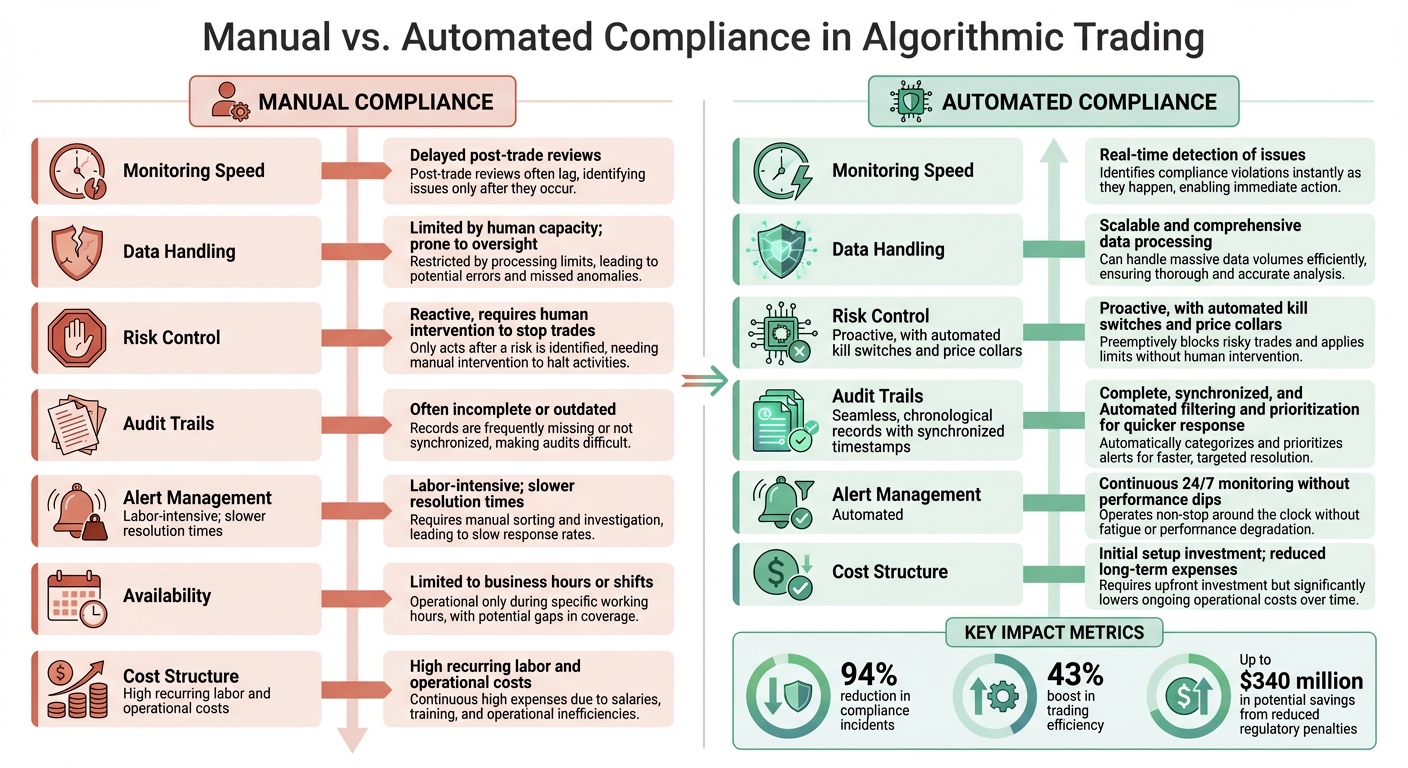
Manual vs Automated Compliance in Algorithmic Trading: Key Differences
Compliance automation is reshaping the way algorithmic trading firms handle their regulatory responsibilities. By replacing manual processes with automated systems, firms can achieve greater speed, precision, and scalability in their compliance efforts, while also minimizing risks.
One of the standout benefits is real-time monitoring. Automated systems can process massive amounts of data instantly without causing delays. In contrast, manual compliance often depends on delayed post-trade reviews, which might overlook critical violations. Such unchecked errors can lead to significant financial losses, sometimes amounting to millions. Automated features like kill switches can immediately halt trading activities, effectively limiting risks. This not only enhances risk control but also allows compliance teams to shift their focus to more strategic initiatives.
Automation also makes better use of resources. Modern trading systems generate an overwhelming number of alerts, which can overburden compliance staff when handled manually. Automated surveillance tools address this by filtering and prioritizing alerts, enabling compliance teams to concentrate on tasks that add greater value.
Another key advantage is the accuracy and consistency that automation brings. Unlike manual processes, which are prone to human errors, automated systems excel at identifying complex manipulation tactics such as quote stuffing, layering, and spoofing. These systems operate in real time, ensuring compliance efforts stay aligned with the fast-changing dynamics of the market.
Manual vs. Automated Compliance
A direct comparison underscores why automation outperforms manual methods:
| Feature | Manual Compliance | Automated Compliance |
|---|---|---|
| Monitoring Speed | Relies on delayed post-trade reviews | Real-time detection of issues |
| Data Handling | Limited by human capacity; prone to oversight | Scalable and comprehensive data processing |
| Risk Control | Reactive, requiring human intervention to stop trades | Proactive, with automated kill switches and price collars |
| Audit Trails | Often incomplete or outdated | Seamless, chronological records with synchronized timestamps |
| Alert Management | Labor-intensive; slower resolution times | Automated filtering and prioritization for quicker response |
| Availability | Limited to business hours or shifts | Continuous 24/7 monitoring without performance dips |
| Cost Structure | High recurring labor and operational costs | Initial setup investment; reduced long-term expenses |
Firms that have embraced robust algorithmic compliance frameworks report a 94% reduction in compliance incidents and a 43% boost in trading efficiency. These improvements not only lower regulatory penalties – potentially saving up to $340 million – but also cut hardware expenses through cloud-based solutions.
Conclusion
Compliance automation has become a critical component in the world of algorithmic trading. With algorithms dominating a significant portion of the market, the sheer speed and complexity of modern trading make manual oversight virtually unmanageable. As the Financial Conduct Authority highlights:
It is essential that firms’ controls and key oversight functions, including compliance and risk management, keep pace with the ever-increasing complexity and speed of financial markets and technological advancements.
The fast-paced evolution of financial markets demands an equally fast and adaptive approach to regulatory compliance. Regulators are ramping up their scrutiny of automated systems, placing a greater emphasis on ensuring these tools meet stringent standards. For trading professionals, this means compliance systems must match the efficiency and speed that algorithmic trading requires.
To address these challenges, MillionMachine provides traders with the ability to test strategies within regulatory frameworks and produce detailed compliance reports – all without the need for coding. Its advanced backtesting and optimization tools enable rigorous testing that aligns with regulatory expectations while maintaining the comprehensive audit trails necessary for compliance.
Automating compliance processes not only helps firms meet regulatory demands but also supports scalable and efficient trading operations. By integrating real-time monitoring, robust controls, and detailed audit documentation, firms can enhance risk management and operational performance. Many have found that investing in compliance automation leads to measurable improvements in both efficiency and long-term sustainability.
MillionMachine.com is a platform designed for research, education, and strategy development. It does not provide personalized investment advice, trading advice, or financial recommendations. The platform is not intended as a solicitation to buy or sell any financial instruments.
Users are responsible for evaluating their own trading decisions and the associated risks. All simulations, backtests, and performance metrics provided by MillionMachine are hypothetical and should not be considered guarantees of future outcomes. Actual trading results can differ significantly from simulated projections.
MillionMachine is not registered as a Commodity Trading Advisor (CTA), Investment Advisor, or Broker-Dealer with the NFA, CFTC, SEC, or any other regulatory body. While the founder was formerly registered as a CTA with the National Futures Association (NFA), that registration is no longer active, and MillionMachine does not engage in regulated advisory activities.
The platform does not execute trades, manage customer funds, or provide access to live trading accounts. Any integrations with broker APIs are strictly for user-initiated and user-controlled automation. Users are fully responsible for ensuring their trading activities comply with all relevant laws, regulations, and broker requirements.
All market data, charts, signals, and analytics displayed by MillionMachine are for informational and educational use only. MillionMachine does not guarantee the accuracy or completeness of market data and assumes no liability for errors, delays, or omissions.
Trading financial instruments such as futures, stocks, cryptocurrencies, and derivatives involves substantial risk and may not be suitable for every investor. Losses can exceed initial investments, and past performance – whether actual or simulated – is not indicative of future results.
FAQs
What are the main elements of compliance automation in algorithmic trading?
Compliance automation in algorithmic trading merges regulatory requirements with tech-driven processes to ensure strategies operate safely, transparently, and within legal boundaries. Key aspects include governance and oversight, which assign accountability for algorithm design and monitoring, and development and testing controls, such as backtesting, code reviews, and overfitting checks to validate strategies before they go live. To mitigate risks, risk controls like pre-trade limits, real-time monitoring, and post-trade analysis are implemented to help avoid market disruptions. Moreover, change management and version control ensure that every algorithm update is documented, while automated audit trails and reporting enhance transparency for regulatory inspections.
Platforms like MillionMachine simplify these processes by providing tools for visual strategy design, testing, and compliance-ready reporting, all without requiring users to write code. By embedding testing logs and optimization results directly into audit trails, firms can efficiently demonstrate regulatory compliance and maintain strong oversight.
MillionMachine.com is a software tool designed for research, education, and strategy development only. Nothing on this website or within the MillionMachine platform should be interpreted as personalized investment advice, trading advice, financial advice, or a solicitation to buy or sell any financial instrument. MillionMachine does not make recommendations or offer guidance on the suitability of any strategy, trade, or investment.
Users are solely responsible for evaluating their own trading decisions and risks. All simulations, backtests, performance metrics, and analytics generated by MillionMachine are hypothetical and are not guarantees of future results. Hypothetical performance has many inherent limitations and does not reflect actual trading. Actual results may differ significantly from simulated outcomes.
MillionMachine is not registered as a Commodity Trading Advisor (CTA), Investment Advisor, or Broker-Dealer with the NFA, CFTC, SEC, or any other regulatory authority. Although the founder was previously registered as a CTA with the National Futures Association (NFA), that registration is no longer active, and MillionMachine does not engage in any regulated advisory activities.
MillionMachine does not execute trades, handle customer funds, or provide access to real-time trading accounts. Any integration with broker APIs is solely for user-initiated, user-controlled automation. Users retain full responsibility for ensuring their trading activity complies with all applicable laws, regulations, and broker requirements.
All market data, charts, derived signals, and analytics displayed by MillionMachine are provided for informational and educational purposes only. MillionMachine does not verify the accuracy or completeness of market data and assumes no responsibility for errors, delays, or omissions.
Trading financial instruments – including futures, stocks, cryptocurrencies, and derivatives – carries significant risk and may not be suitable for all investors. You can lose more than your initial investment. Past performance, whether actual or simulated, is not indicative of future results.
By using MillionMachine.com, you acknowledge and agree that you are solely responsible for your own investment decisions and that MillionMachine, its creators, and affiliates are not liable for any losses, damages, or trading outcomes arising from use of the platform.
How do international regulations impact compliance in algorithmic trading?
International regulations classify algorithmic trading as a high-risk activity, compelling firms operating across borders to navigate a maze of rules. In the United States, the SEC enforces Regulation SCI and Rule 15c3-5, which require firms to maintain system-wide records, conduct stress testing, and implement real-time risk monitoring. Senior management is also held accountable for ensuring proper oversight. Across the Atlantic, Europe’s MiFID II and Market Abuse Regulation (MAR) impose strict requirements, including pre-trade controls, post-trade reporting, and detailed audit trails for trading algorithms. In Asia-Pacific, the focus shifts to real-time surveillance and data security, often with regulations that differ significantly from those in the U.S. or EU.
Global firms face hurdles such as conflicting jurisdictional requirements – like variations in record-keeping intervals or differing definitions of risk thresholds. To tackle these challenges, automating compliance workflows becomes essential. Tools like MillionMachine offer solutions by allowing users to design trading strategies, test for overfitting, and create regulator-ready reports without needing to code. This streamlines the process of meeting the demands of multiple regulatory environments.
To ensure compliance, firms must adopt centralized governance frameworks, keep track of regulatory updates, and automate necessary filings. Falling short of these requirements can lead to fines, trading restrictions, or even damage to a firm’s reputation. For international algorithmic trading operations, robust compliance automation isn’t optional – it’s essential.
What are the advantages of automating compliance processes in algorithmic trading?
Automating compliance processes in algorithmic trading comes with a host of advantages. For one, it enables quicker and more efficient oversight, allowing firms to keep up with the fast-paced and intricate nature of today’s markets. These systems ensure uniform enforcement of rules and help minimize human errors, both of which are essential for adhering to regulatory standards.
By simplifying workflows and boosting precision, automation frees up resources for firms to concentrate on strategy development and improving performance, all while staying compliant with industry rules. This not only improves day-to-day operations but also lowers the risks tied to manual oversight.

