
Overfitting in trading happens when a strategy is overly optimized for historical data, making it ineffective in live markets. It often results from excessive parameter tweaking, data mining bias, or overly complex designs. While backtests may show impressive results, these strategies often fail when applied to new data, leading to losses.
Key points to understand:
- Overfitted strategies mistake random market noise for genuine patterns.
- Excessive tuning of parameters creates strategies that work only for past data.
- Data mining bias leads to finding false patterns due to testing too many datasets.
- Complex strategies often memorize historical quirks, not real trends.
To avoid overfitting:
- Use out-of-sample testing to validate strategies on unseen data.
- Apply walk-forward analysis to simulate real-time conditions.
- Run Monte Carlo simulations to test strategy stability under various scenarios.
- Keep strategies simple and avoid unnecessary complexity.
Overfitting can lead to misleading backtest metrics, unstable performance, and unexpected losses. Tools like MillionMachine help traders build and validate strategies, focusing on simplicity and robust testing methods to ensure strategies align with market realities.
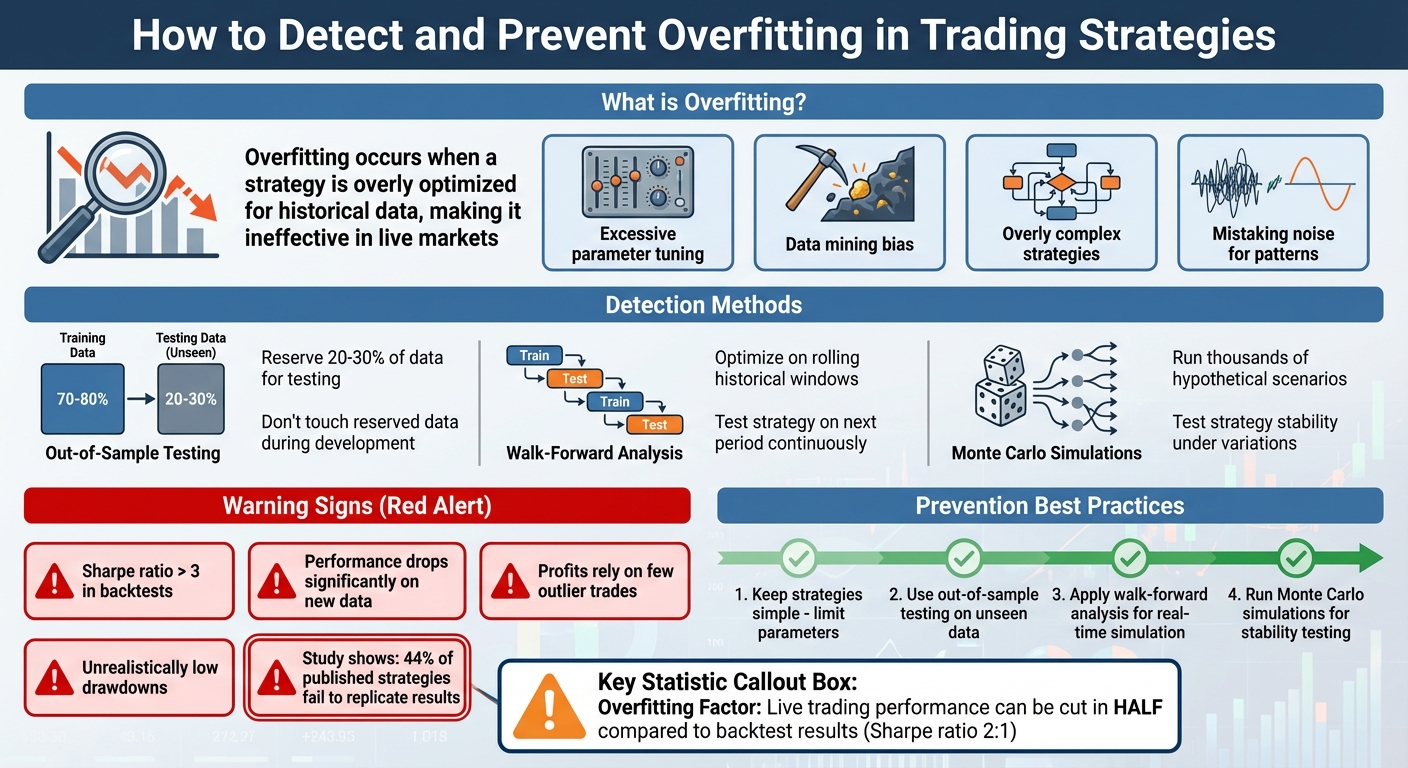
How to Detect and Prevent Overfitting in Trading Strategies
Overfitting in Trading Strategies – How to Avoid It
How Overfitting Happens During Backtesting and Optimization
Overfitting sneaks into trading strategies through excessive parameter tweaking, data mining bias, and unnecessarily complex designs. Let’s break down how each of these factors plays a role.
Excessive Parameter Tuning
Excessive parameter tuning, often called curve-fitting, happens when a strategy is adjusted repeatedly to achieve flawless historical results. Parameters like moving average periods, stop-loss levels, or position sizing rules are fine-tuned to fit past data perfectly. While this might look impressive on paper, it often means the strategy is merely aligning itself with random noise rather than actual market behavior.
Modern computing power exacerbates this issue by allowing thousands of parameter variations to be tested rapidly, often selecting the one that performed best historically. Unfortunately, this often leads to overfitting, which can cause a strategy to fail in live trading.
"Trading strategy developers have long known that ‘curve-fitting’ a strategy to historical data (overfitting) creates an illusion of success that rarely holds up in live markets. Over-optimizing parameters to perfectly fit past price patterns may produce stellar backtest results, but it typically does not translate into real profits going forward." – TradingView
A study conducted by Quantopian on 888 strategies revealed a sobering truth: the more a trader optimized their strategy, the worse it performed in real-world conditions. Each additional parameter increases the likelihood of overfitting, making the strategy less effective in adapting to future market changes.
Data Mining Bias
Data mining bias occurs when too many strategies or datasets are tested, increasing the chances of finding patterns that exist purely by coincidence. Research by Bailey and López de Prado highlights this issue, showing that testing countless variations almost guarantees the discovery of seemingly effective strategies that lack any real edge. This is particularly problematic in financial markets, where the signal-to-noise ratio is notoriously low, making it easy to mistake random patterns for meaningful insights.
Professor Cam Harvey of Duke University’s Fuqua School of Business summed up the problem:
"There is just too much data mining going on now in finance!" – Cam Harvey
For instance, a moving average strategy might show a Sharpe ratio of 1.2 during backtesting but drop to –0.2 when tested on new data. This kind of result reveals that the strategy had only captured random historical fluctuations rather than a genuine pattern.
Overly Complex Strategies
It’s tempting to think that adding more rules, conditions, and parameters will improve a trading strategy. However, increased complexity often backfires, as it tends to capture noise instead of actual market trends. Machine learning models provide a clear example of this problem. One neural network model, for instance, achieved a training set ROC AUC of 0.944 but only managed 0.855 on test data. This discrepancy showed that the model had memorized the training data rather than learning patterns that could generalize effectively.
Mathematician John von Neumann famously illustrated this point:
"With four parameters I can fit an elephant, and with five I can make him wiggle his trunk." – John von Neumann
The takeaway? Simpler strategies are often more reliable. They’re easier to understand, implement, and adjust over time. Instead of overloading your strategy with rules, focus on straightforward approaches that rely on observable trends.
The Impact of Overfitted Strategies on Live Trading
Overfitted strategies that shine during backtesting often falter in live trading, leading to unexpected losses and frustration.
Misleading Backtest Metrics
Overfitted strategies tend to boast impressive backtest metrics – high Sharpe ratios, excellent win rates, and attractive profit factors. But these numbers can be deceiving. Research indicates that metrics like the Sharpe ratio have minimal predictive power for out-of-sample performance, with an R² of less than 0.025. In simpler terms, a stellar Sharpe ratio in backtesting offers little assurance that the strategy will perform well in live markets.
Metrics like Sharpe or Sortino ratios exceeding 3 in backtests are especially suspect. Such figures are rare in real trading and often signal that the strategy has been overly tailored to a specific market phase. Another red flag is when a strategy’s backtest profits rely heavily on a few outlier trades. If most of the gains come from just a handful of exceptional trades, the strategy is likely overfit to historical quirks rather than built on a sustainable edge. Similarly, unrealistically low maximum drawdowns in backtests can point to overfitting during periods of low market volatility, setting the stage for nasty surprises when conditions change.
Challenges in Live Trading
The trouble with overfitted strategies is that their impressive backtest results rarely translate to real-world performance. Why? Because these strategies are fine-tuned to historical data patterns that are unlikely to repeat. Instead of capturing genuine market signals, they latch onto random noise.
This mismatch leads to serious issues. Performance in live trading often deteriorates, resulting in unstable or negative returns, unexpected large drawdowns, excessive trading with high transaction costs, and poor market timing. A 2014 study revealed that 44% of published trading strategies failed to replicate their backtest success when applied to new data.
Professor Cam Harvey from Duke University’s Fuqua School of Business explains the problem well:
"An overfitted strategy will likely underperform when faced with new data, be it the out-of-sample the analyst has not yet looked at, or when placed into live trading. This happens because the model does not adequately describe the effect but rather the noise in the data, so when you apply it to data it does not know, it becomes much less efficient."
The "overfitting factor" illustrates this issue starkly. For typical CTA strategies with Sharpe ratios between 0.3 and 0.5, the ratio of expected in-sample Sharpe to expected out-of-sample Sharpe can be as high as 2. In practical terms, live trading performance could be slashed in half compared to backtest results. Beyond the financial losses from capital depletion and higher transaction costs, overfitting squanders development time, causes traders to miss out on better opportunities, and can harm credibility when strategies fail.
sbb-itb-e64548c
How to Detect Overfitting
Spotting overfitting early – before it leads to losses – requires more than just backtesting. You need to push your trading strategy into unfamiliar territory to see if it holds up. This process helps determine whether your strategy is identifying real market trends or just clinging to historical quirks. Here are some effective ways to assess this.
Out-of-Sample Testing
Set aside 20–30% of your historical data and don’t touch it while developing your strategy. Use the remaining data (the in-sample set) to build and optimize your approach. Once that’s done, test the strategy on the reserved data. If it performs well, it’s a sign your strategy might have identified real market behavior. But if performance drops significantly, overfitting could be the culprit. Be careful not to tweak parameters based on these out-of-sample results – this keeps the test unbiased.
Walk-Forward Analysis
Think of walk-forward analysis as an advanced version of out-of-sample testing. Here, you optimize your strategy on a rolling window of historical data and then test it on the next period. For example, you might fine-tune your strategy using six months of data, then test it on the following month, moving the window forward after each test. This method mimics real-time conditions and checks if your strategy can handle changing market dynamics. It’s a great way to see if your approach is adaptable or stuck in the past.
Monte Carlo Simulations
Monte Carlo simulations put your strategy through thousands of hypothetical scenarios by shaking up the data. You might shuffle the order of trades, adjust execution prices slightly to simulate slippage, or remove some trades to mimic missed opportunities. These tests reveal how sensitive your results are to specific historical events. Run a large number of simulations to ensure reliability. If you notice big swings in performance or extreme drawdowns, it’s a red flag for overfitting.
How to Prevent Overfitting with MillionMachine

MillionMachine provides traders with tools designed to tackle overfitting head-on, ensuring that strategies align with actual market behavior rather than just past patterns.
Simplify Strategies with Visual Design Tools
Keeping strategies simple is one of the best ways to avoid overfitting. MillionMachine’s visual strategy builder helps you focus on the key market signals, cutting out unnecessary complexity. You can describe your trading ideas in plain language and visually test those rules directly on price charts. This makes it easier to spot when extra parameters are creeping in. By limiting the number of parameters – especially when working with smaller datasets – you can build strategies that are more resilient and less prone to being overly tailored to historical data.
Use Parameter Optimization Tools
Simplicity is powerful, but MillionMachine takes it a step further with parameter optimization tools. These tools systematically test different parameter combinations, helping you find ranges that perform consistently well. Instead of chasing a single "perfect" value that might just reflect overfitting, this approach ensures your strategy works across various scenarios. The platform’s simulation methods are designed to identify reliable ranges rather than over-tuned solutions.
Validate Strategies with Built-In Testing Features
Validation is crucial to ensure your strategy can handle real-world market conditions. MillionMachine offers built-in tools for out-of-sample testing and walk-forward analysis, allowing you to see how your strategy performs with unseen data. You can test strategies across a wide range of assets – stocks, futures, currencies, ETFs, and crypto – to confirm they generalize well across different markets. These features make it easier to verify that your strategy remains robust over time, not just in historical simulations.
Conclusion
Overfitting can sabotage live trading by mistaking market noise for genuine signals, resulting in backtest results that look impressive but fail miserably in real-world conditions. The outcomes? Unstable returns and unexpected drawdowns. As David H. Bailey from Lawrence Berkeley National Laboratory explains:
"Backtest overfitting is now thought to be a primary reason why quantitative investment models and strategies that look good on paper often disappoint in practice".
To avoid this pitfall, focus on simplicity, rigorous validation, and identifying genuine market signals. Keep your strategy’s parameters limited and test them on fresh, unseen data using methods like out-of-sample testing, walk-forward analysis, and Monte Carlo simulations. These techniques help distinguish strategies rooted in enduring market principles from those that merely capitalized on historical quirks.
MillionMachine incorporates these principles into its design. Its intuitive tools help manage complexity, while parameter optimization features guide you toward robust settings rather than over-tuned ones. Built-in validation tools allow you to test strategies across different asset classes and market conditions, ensuring they’re prepared for future challenges – not just past performance.
Effective strategies prioritize adaptability over perfect historical metrics. By understanding overfitting and using tools designed to prevent it, you can craft strategies with a genuine edge – ones that perform reliably across ever-changing market landscapes.
MillionMachine.com is a platform intended for research, education, and strategy development only. Nothing on the site or within the MillionMachine platform should be construed as personalized investment advice, trading advice, financial advice, or a solicitation to buy or sell any financial instrument. MillionMachine does not provide specific recommendations or evaluate the suitability of any strategy, trade, or investment.
Users are fully responsible for assessing their own trading decisions and risks. All simulations, backtests, performance metrics, and analytics provided by MillionMachine are hypothetical and do not guarantee future results. Hypothetical performance has inherent limitations and does not reflect actual trading outcomes. Actual results may vary significantly from simulated performance.
MillionMachine is not registered as a Commodity Trading Advisor (CTA), Investment Advisor, or Broker-Dealer with the NFA, CFTC, SEC, or any other regulatory body. While the founder was previously registered as a CTA with the National Futures Association (NFA), that registration is no longer active, and MillionMachine does not engage in regulated advisory activities.
MillionMachine does not execute trades, manage customer funds, or provide access to live trading accounts. Any integration with broker APIs is strictly for user-initiated and user-controlled automation. Users bear full responsibility for ensuring their trading activity complies with all applicable laws, regulations, and broker requirements.
All market data, charts, signals, and analytics provided by MillionMachine are for informational and educational purposes only. MillionMachine does not guarantee the accuracy or completeness of market data and is not responsible for errors, delays, or omissions.
Trading financial instruments – including futures, stocks, cryptocurrencies, and derivatives – carries substantial risk and may not suit all investors. It is possible to lose more than your initial investment. Past performance, whether simulated or actual, is not indicative of future results.
FAQs
How do I know if my trading strategy is overfitted?
An overfitted trading strategy often stands out due to certain telltale signs. These include unrealistically high backtested returns, smooth equity curves with minimal or no drawdowns, or exceptional performance confined to a specific asset or timeframe. Another red flag is the presence of overly intricate rules or strategies that become highly sensitive to even minor tweaks in their parameters.
One of the clearest indicators of overfitting is poor performance during out-of-sample testing – when a strategy struggles to replicate its success on fresh, unseen data. To steer clear of overfitting, aim to develop strategies that perform reliably across varying market conditions. Techniques like out-of-sample testing, walk-forward analysis, and Monte Carlo simulations can help ensure your strategy is robust and adaptable.
What are the dangers of using an overfitted trading strategy?
Overfitting in a trading strategy can spell trouble in live markets. Why? Because it’s designed to fit past data too perfectly, often picking up on random noise or patterns that aren’t likely to happen again. This can lead to poor performance when faced with new, unpredictable market conditions, increasing the risk of financial losses.
What’s more, overfitting can generate unreliable trading signals, which might push you into overtrading. This not only racks up transaction costs but also adds unnecessary layers of complexity to your strategy. To steer clear of these issues, it’s essential to rigorously test your strategies and ensure they’re flexible enough to handle a variety of market scenarios effectively.
What are some effective ways to simplify a trading strategy and reduce overfitting?
To keep your trading strategy effective and avoid overfitting, aim for simplicity and reliability. Stick to using fewer parameters and steer clear of overly complicated models that might only excel with historical data but falter in new situations. Make sure to test your strategy on out-of-sample data – this helps confirm that it performs well in market conditions it hasn’t encountered before. You might also want to use walk-forward analysis, which validates performance over time and highlights any potential weaknesses. These approaches can help you create strategies that hold up better in actual trading environments.

